
Technical Due Diligence (TDD) is an independent engineering audit conducted in the context of mergers, acquisitions, and investments in industrial or infrastructure assets. Its main objective is to mitigate the caveat emptor principle (buyer’s duty of care) by identifying hidden risks, structural defects, and physical liabilities that could compromise production capacity or generate unforeseen maintenance costs. The process quantifies the necessary capital expenditures (CAPEX) for repairs, providing reliable data to support pricing decisions and protect the return on invested capital.
Want to learn about the steps in a standard TDD workflow and find out how to assess the risks of your next asset? Keep reading the article below!
INTRODUCTION
Firstly, in the context of mergers, acquisitions, and investments, it is common to carry out a process called Due Diligence. This process consists of a detailed assessment of documents related to fundamental aspects of the business, such as contracts, tax, labor, and environmental compliance, as well as an analysis of revenues, costs, and liabilities. The objective is to identify potential risks and obligations, reducing uncertainties and supporting decision-making. The expression caveat emptor (buyer beware) reflects the importance of rigorous analysis before any purchase decision.
However, in many cases, the main risks lie in the documents and physical condition of the assets being acquired. As a result, any future high maintenance costs, penalties for unavailability, or production losses resulting from structural failures can significantly alter the projected return on an investment.
In this sense, infrastructure (bridges, viaducts, highways, ports, airports, water or sewage treatment plants, etc.), buildings, industrial plants, energy and sanitation projects are clear examples of the need to assess technical engineering aspects before an acquisition or investment.
Thus, the assessment of these factors within the Due Diligence process is known asTechnical DueDiligence (TDD ). Its purpose is to provide reliable technical information to support pricing, guide negotiations, and, when necessary, reassess the viability of the business according to the investor's risk appetite.
In addition, TDD enables:
- Quantify investments needed for repairs, adjustments, or expansions;
- Assess the condition and structural performance of assets;
- Identify hidden risks to safety and production capacity;
- Establish an initial basis for Structural Integrity programs.
Regarding ongoing asset management programs, such as CARE, TDD has two main differences: a shorter time horizon and a level of detail adjusted to the investment decision context.
In this context, this article presents a typical TDD execution flow, the key information collected at each stage, and the benefits obtained when physical availability and maintenance costs are critical factors for the success of an investment.
EVALUATION FLOW
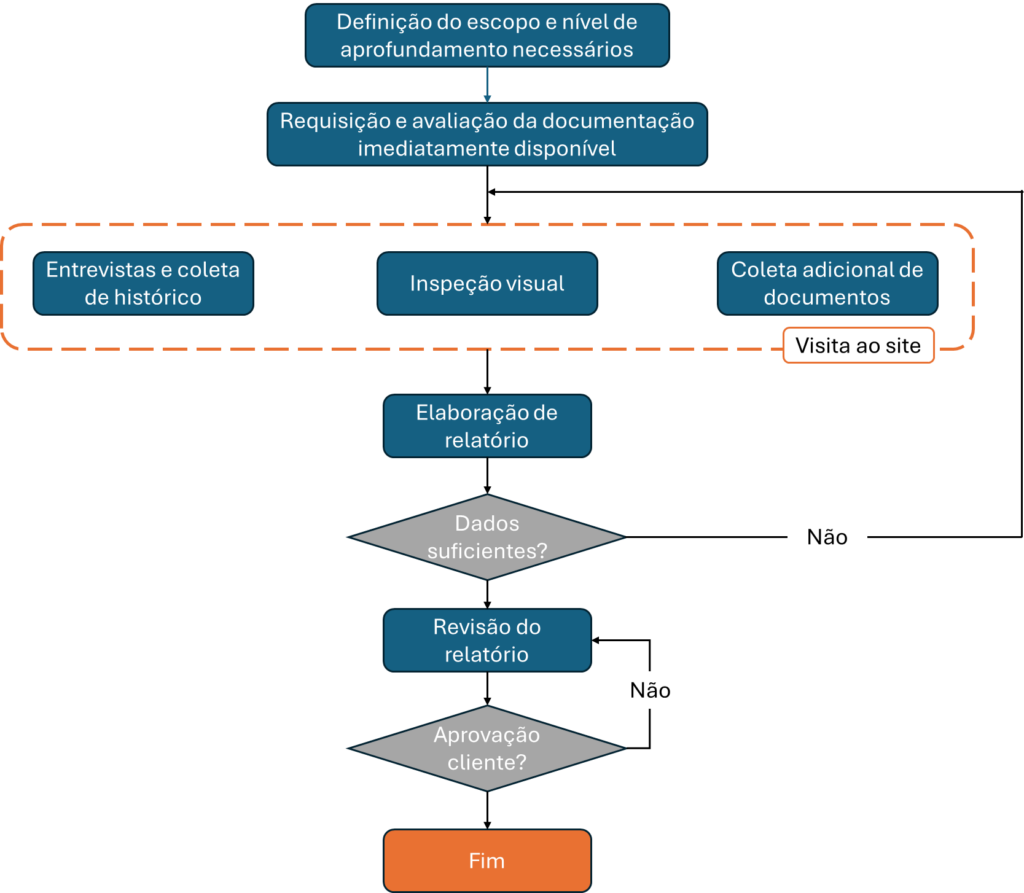
Image: Standard workflow for technical due diligence. Modified from: The methodology of technical due diligence report preparation for an office, residential, and industrial buildings.
Scope definition and alignment of expectations
Currently, Brazil lacks specific regulations for the implementation of TDD. However, there are international references that establish minimum criteria to be followed, for example, ASTM E2018-15 (Standard Guide for Property Condition Assessments).
Therefore, the level of depth of the investigation must be defined according to the objective of the study and the risk profile of the contractor. Factors such as available time, risk tolerance, criticality of certain assets, aggressive environmental conditions, and the need to evaluate auxiliary structures or protection systems must be aligned in advance. Based on this guidance, the investigation strategy is structured.
Evaluation of documents, processes, and interviews
The objective of this stage is to understand the history of the assets, identify critical inspection points, and assess the quality of the available documentation.
The main sources of information include:
- Interviews with professionals involved in the design, implementation, operation, and maintenance;
- Records of inspections, maintenance, structural modifications, and history of failures or accidents;
- Drawings, calculation memories, CQP, technical specifications, and information on processes and installed equipment.
In fact, the information will not always be complete or up to date. Therefore, field validation becomes essential to reduce uncertainties and confirm technical assumptions.
Field assessments and inspections
This is generally the most critical stage of the process, as it provides a current view of the physical condition of the assets and validates the information previously collected. The article on visual inspection of structural assets provides a more in-depth look at this topic.
In order to ensure reliable results, the following should be considered:
- Proper logistics planning, including teams, access, equipment, and available documentation;
- Clear definition of responsibilities and, when necessary, formation of multidisciplinary teams;
- Assets of greater relevance to the business (whether from a safety or production standpoint) may require topography, scanning, concrete testing, tests on metal structures, extensometry, accelerometry, movement amplification , etc. These methodologies are useful in evaluating in-service performance, estimating remaining service life, or materials to be used in recovery services, for example.
- Older buildings on an industrial site; piers, ship loaders and unloaders in seaports; OAE's on a stretch of highway and railroad; towers of a power transmission line; warehouses and railways at a logistics terminal, tanks in a sanitation system; yard machinery at a mining plant, are some examples of structures that may occasionally undergo greater scrutiny during the TDD.
Therefore, field investigations must be conducted objectively and quickly, seeking to answer the main questions of the process through representative sampling and careful technical analysis.
Technical Report decision support
Until the treatment and prioritization are carried out, the report presents only a grouping of information with little practical value for the parties involved in the negotiation, especially for those who do not have engineering as their main area of expertise. Therefore, it is essential that the main results of the investigation be translated into recommendations and useful information to facilitate negotiations.
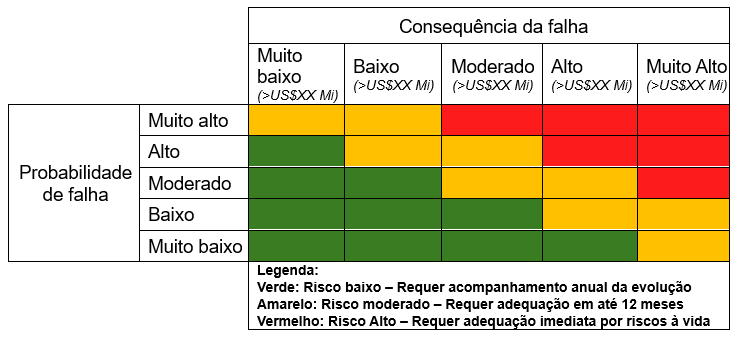
The greatest complexity of this stage lies in the fact that there are different levels of probability and consequences for both non-conformities and assessed assets. Non-conformities can range from aesthetic issues (such as a crack in the coating) to problems that require immediate repair for safety reasons. Similarly, some structural assets have easily fixable flaws, while others can pose significant risks to human life, interruptions in production lines, or serious environmental impacts. This balance is addressed in more detail in the article on Structural Safety.
In this sense, an effective way to facilitate decision-making is to classify identified deviations based on risk, usually accompanied by an estimate of the costs involved in making adjustments. The figure below shows a possible risk classification matrix.
Table: Example of a risk matrix in the context of a TDD.
Furthermore, it is interesting to note that the time frame for making adjustments is another piece of information that allows for the composition of investment plans and negotiations.
Sometimes, evaluations performed via TDD have limited scope and duration, which prevents the complete evaluation and diagnosis of an identified defect. In such cases, complementary studies may be recommended, such as MEF (e.g., definition of reinforcements or the adequacy of structures in light of new regulatory requirements) or laboratory tests (e.g., investigations of expansive reactions in concrete, mechanical characterization of steel and concrete).
CONCLUSION
In summary, Technical Due Diligence plays a strategic role in acquisition, financing, and investment processes involving industrial and infrastructure assets.
Thus, by assessing physical conditions, performance, and associated risks, TDD allows for more accurate estimates of future investments, reduces uncertainty, and avoids operational surprises that could compromise expected returns.
Above all, more than a technical diagnosis, TDD is a tool for risk management and protection of invested capital.
Thus, by providing a clear view of the integrity, reliability, and useful life of assets, the process contributes to safer negotiations, decisions aligned with risk appetite, and greater economic predictability throughout the project's life cycle.
Overall, in an investment environment increasingly driven by performance and reliability, Technical Due Diligence becomes an essential differentiator for well-founded technical decisions. Acquisition, expansion, or financing projects require technical certainty and predictability.
Kot Engenharia investors, operators, and financial institutions in conducting technical due diligence, integrity assessments, and CAPEX estimates, providing critical information for negotiations and decision-making. Contact us and talk to our experts.
Follow our pages on LinkedIn, Facebook and Instagram and keep following our content.
FAQ
1. What is the difference between traditional due diligence and technical due diligence (TDD)?
Traditional due diligence focuses on a detailed assessment of contractual documents, as well as tax, labor, and environmental compliance, and the business’s financial liabilities. Technical Due Diligence (TDD), on the other hand, focuses on the physical condition, Structural Integrity operational performance of tangible assets (such as industrial plants, ports, bridges, and fleets). TDD helps prevent financial surprises resulting from mechanical failures or urgent maintenance needs that do not appear on balance sheets.
2. What types of infrastructure and assets require a TDD to be performed?
TDD is highly recommended for complex engineering assets where physical availability and operating costs are critical to the success of the investment. This includes infrastructure projects (bridges, overpasses, highways, ports, airports, railroads), commercial buildings, complete industrial plants, energy projects (transmission lines), sanitation systems (treatment plants, tanks), and heavy mining equipment (yard machinery and ship loaders).
3. Which regulation governs the performance of a TDD in the Brazilian market?
Currently, Brazil does not have specific national standards for conducting technical due diligence. For this reason, engineers and investors rely primarily on established international standards, particularly the American standard ASTM E2018-15 (Standard Guide for Property Condition Assessments), which sets forth the minimum criteria and guidelines for the strategic conduct of these assessments.
4. What is the difference between TDD and a continuous asset management program like CARE?
Although both assess the integrity of structures and equipment, TDD differs from ongoing asset management programs (such as CARE) in two key ways: it has a significantly shorter time horizon and employs a level of detail that is perfectly suited to the urgent context of investment decision-making or purchase negotiations.
5. What are the main steps that make up the standard TDD workflow?
The standard process for a Technical Due Diligence is divided into four essential phases: 1) Defining the scope of the investigation and aligning it with the client’s risk appetite; 2) Thorough evaluation of documents (drawings, calculation reports, failure histories) and conducting interviews with the facility’s staff; 3) On-site assessments, surveys, and physical inspections; and 4) Issuance of Technical Report risk classifications and recommendations to support decision-making.
6. How does the Technical Report help translate engineering data for investors?
To ensure practical value for non-engineering decision-makers, the TDD report translates the physical deviations identified into a risk classification matrix, weighing the probability and severity of the consequences of each failure. These risks are accompanied by financial estimates of compliance costs (CAPEX) and implementation timelines, allowing the buyer to adjust the offer price for the asset or reassess the feasibility of the deal.