
What is structural safety?
Structural safety is the condition in which a structure operates with the expected performance. A more technical and precise definition is given by Leonhardt and Monning, who state that the concept refers to the structure's ability to withstand actions and stresses with adequate clearance [1].
This definition drawn up by the authors, who are a reference in studies of reinforced concrete structures, is interesting because it presents two of the most relevant concepts to the subject: capacity (or resistance) and request (or action).
Capacity: strength, performance and durability
The capacity of a structure generally refers to its mechanical resistance, i.e. the maximum effort that the structure is capable of withstanding. In addition, when the context in question is that of resistance, performance must also be taken into account according to the structural purpose.
For example, in order for a certain slab to support a piece of high-precision mechanical equipment, in addition to resisting the efforts employed by the object in operation, it is also necessary to check that the displacements occurring in the structure are compatible with the tolerances associated with the precision of the machine in question.
Based on this assessment, the potential conservation capacity of a structure throughout its useful life is verified, i.e. its durability. Phenomena such as the action of corrosive agents and the aggressiveness of the environment are taken into account in this analysis.
Stresses: expected use, useful life and life stages of a structure
In short, requests consist of everything that requires a response from the structure:
-
- Gravitational loads: the structure's own weight and the weight of what is supported on it;
-
- Actions influenced by the environment: sunshine, wind, rain, temperature variations, etc;
-
- Actions arising from the use of the structure: overloads from use, accumulation of materials, dynamic loads, etc;
-
- Extraordinary actions (which may or may not occur): impact caused by a vehicle colliding with a viaduct pillar, for example.
Naturally, the stresses depend on the intended use of the structure. A viaduct, for example, is subject to different stresses than an industrial process building.
In addition, the expected lifespan of each structure is also a factor to consider. For example, the useful life of a bridge is directly related to the number of vehicles that will pass over it. This number is also one of the relevant parameters for its design based on the fatigue resistance criterion, which is used for special structures.
In this sense, once the structure's admissible capacity and the stresses acting on it have been determined, these quantities are compared, as shown in Figure 1.
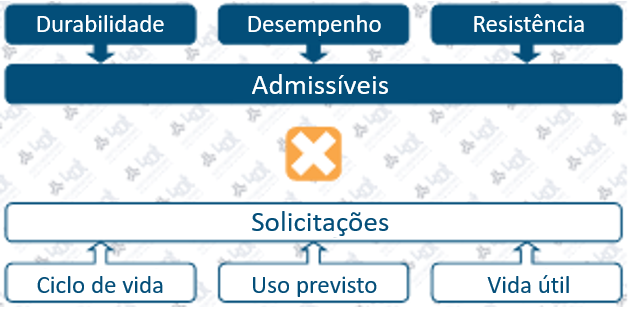
Figure 1: Comparison between quantities. SOURCE: Kot Collection.
Thus, when the admissible values are higher than the stress values, it is correct to say that the structure or equipment is fit for operation. Otherwise, modifications or reinforcements are required.
Structural safety assessment methodologies
From this concept of structural safety, it remains to be clarified how the process is carried out. As such, there are different methodologies for assessing structural safety, and this article presents the two most widely used methods in recent decades.
Allowable stress method (ASD)
Firstly, the Allowable Stress Design (ASD) method is the oldest and its main advantages are its simplicity and speed. Traditionally, all expected stresses are considered simultaneously with their expected value - known as the nominal value - although different considerations can be used depending on the specific scenario.
The structural analysis is then carried out and the stresses are obtained and compared with the admissible values, which consist of the material's resistance stress reduced by a pre-set global safety factor. The safety factor is defined by the technical standards and its value is established on the basis of the experience of the engineers who make up the standards committees.
It can therefore be said that the main disadvantage of the ASD method is its experience-based methodology, since the associated risk of errors is not scientifically known. As a result, this method has fallen into disuse and is not currently adopted by the main international technical standards in the structures sector.
Limit State Method (LRFD)
This method, known as the partial factor method or Load and Resistance Factor Design (LRFD), has the main advantage of applying probability theory to define the values of stresses and resistances [3].
In contrast to ASD, LRFD does not use a global safety factor. Instead, factors are applied to increase loads and reduce resistances. These factors, known as partial factors, are defined statistically in order to obtain an already known probability of failure, taking into account the following aspects [2]:
-
- The possibility of an action being greater than expected;
-
- The possibility of several actions taking place simultaneously;
-
- The possibility of the material's resistance being lower than expected;
-
- Uncertainties related to the effects of the actions, the geometric properties of the structure and the specific characteristics of the material.
This probability of failure varies according to the set of standards used. In Brazil, for example, the ABNT NBR 6118:2014 standard for reinforced concrete structures states that:
"For the purposes of this standard, the lower characteristic strength (of concrete) is assumed to be the value that has only a 5% probability of not being reached (...)."
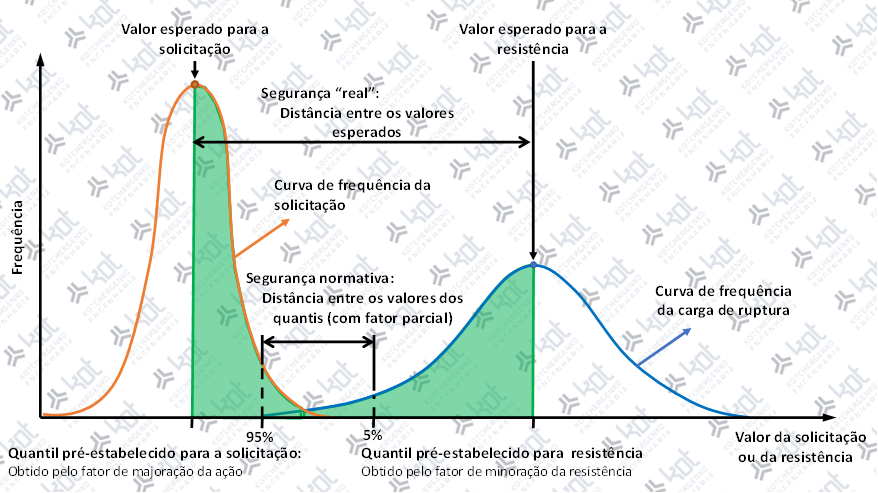
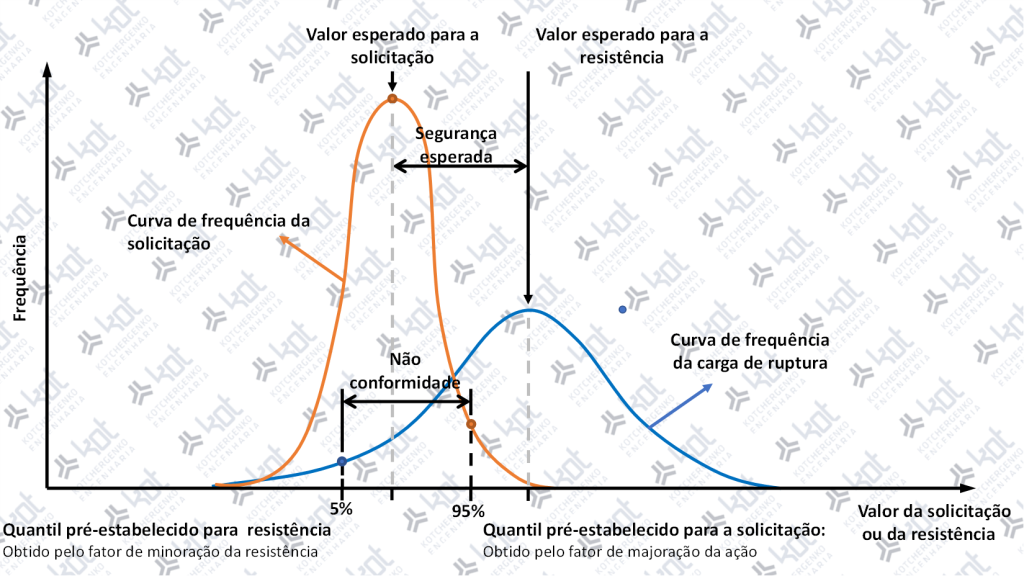
In other words, even if the resistance reduction factors are applied, the material's resistance will be lower than the design value in 5% of cases, as shown in the graph in Figure 2. The same reasoning applies to the stresses: they will be increased, but it is possible that their design value will be exceeded.
Furthermore, it is important to note that the method in question is guided by limit states, which are defined, according to the Brazilian standard ABNT NBR 8681:2003, as:
"States from which the structure performs inadequately for the purposes of the construction."
In other words, they are undesired conditions that must be avoided when designing the structure, which are divided into 2 (two) groups: ultimate limit states (ULS) and service limit states (SLS), as illustrated in Figure 3 below.

Ultimate limit states (ULS)
In relation to resistance, when an ULS is detected, the structure or part of it must be stopped. As a result, each set of standards generally defines the ULS that must be checked in a structure. In Brazil, this aspect is again covered by the ABNT NBR 8681:2003 standard, which presents the following ULSs for mandatory assessment:
-
- Rigid body movement: when a structure moves as a whole. It is most common during the construction phase of the structure;
-
- Rupture: when a structural component has less mechanical strength than required;
-
- Dynamic: when the dynamic response leads the structure to instability;
-
- Buckling: when the structure becomes unstable due to its deformation, even if rupture has not yet been reached.
Service limit states (SLS)
Related to the performance and durability of the structure, when an ELS is detected, the structure does not meet the objectives for which it was built. Although it does not indicate imminent failure, the occurrence of an ELS is characterized as a non-conformity.
ABNT NBR 8681:2003 indicates that ELSs are characterized by:
-
- Excessive or uncomfortable vibration: repetitive movements that make it difficult and/or impossible for an individual to remain in the structure;
-
- Excessive displacements: displacements that can impair the use of the structure. For example, a slab that has deformed and started to accumulate water in the area;
-
- Minor damage: deformations that cause minor damage but do not compromise the structure, such as cracks in the corners of windows.
Interpretation and evaluation of results
Although introductory, the concepts discussed in this article help in the interpretation and basic evaluation of results obtained in structural checks. Therefore, as with calculation reports and technical reports, when evaluating these results, it is important to take a few steps:
-
- Identify which methodology was used to assess structural safety.
It is important to be aware of which set of regulations and which methodology are being used. In most countries (such as Brazil, Europe, Australia and the United States), the current methodology is the Limit State Method. However, some sectors of industry still use the Allowable Stress Method for specific assets.
-
- Identify whether all relevant limit states have been assessed.
It is extremely important to check that structural components can withstand the construction process. Steel or reinforced concrete parts, for example, can be lifted during construction and this operation can be a critical condition for these components, as shown in Figure 4.
In addition, the structure must also be evaluated under maintenance conditions. In bridges and viaducts, for example, they are of great importance, since these structures have special devices in the support areas and their maintenance may require their suspension by means of hydraulic cylinders.
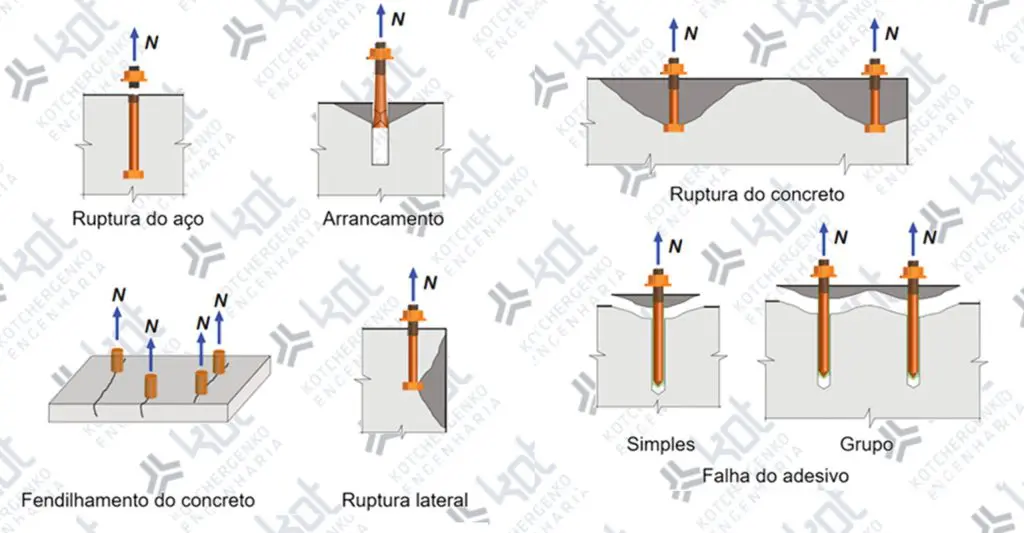
Furthermore, the possible limit states also depend on the nature of the stress. For example, in a base connection that is only stressed in tension, all the associated failure modes must be evaluated [9], but there is no need to check the failure modes related to the shear of the connection.
-
- Evaluation of the safety factors used.
If the methodology adopted is that of admissible stresses (ASD), a global safety factor is used, the value of which may have been established by standard or by good engineering practice. It should be noted that it is important to assess whether the safety factor adopted is compatible with the failure mode and the acting stress.
When the verification method is based on ultimate limit states, there are partial factors that increase the loads and partial factors that reduce the resistance, which are defined by standards based on well-defined methodologies.
In Brazil, the partial action factors are available in the ABNT NBR 8681:2003 standard, while the partial resistance reduction factors are obtained from the standard that regulates the type of structure in question. For steel structures, for example, ABNT NBR 8800:2008 should be consulted; for conventional reinforced concrete structures, ABNT NBR 6118:2014; while for the design of timber structures, ABNT NBR 7190:2022 is the standard to be consulted.
Furthermore, it is important to assess the coherence of the combinations of actions used, especially when the limit state methodology is applied. For ULSs, the type of combination adopted (normal, special, construction or exceptional) must be compatible with the failure mode considered and the actions involved. In other words, if you are assessing the failure of a structural component during use, it makes no sense to include the construction overload in the combination of actions, since this loading is only foreseen in the construction phase of the structure.
Likewise, the assessment of SLSs must be consistent with the performance and durability criteria being assessed. A check for excessive displacements, for example, should be carried out taking into account the possible occurrences of loading on the structure for a large part of the time, and not just in occasional scenarios.
-
- Evaluation of the values used in the requesting actions.
As we have already seen, the load-bearing stress is only one of the factors in the equation for the structural verification process, and the values adopted for the load-bearing actions are equally important.
In this sense, it should be assessed whether the values used are consistent with those expected, as well as investigating whether the result of the combined demands is in the expected order of magnitude.
These checks have become increasingly relevant with the spread of structural design software. These programs often prioritize productivity and make assumptions not previously considered in order to avoid user intervention. On the other hand, these programs reduce the occurrence of errors in the definition of resistance values. As a result, it is common for the divergence between independent analyses to lie in the considerations regarding the acting actions.
-
- What does structural non-compliance mean? Will the structure collapse if it is non-compliant? Can I keep my structure/equipment like this?
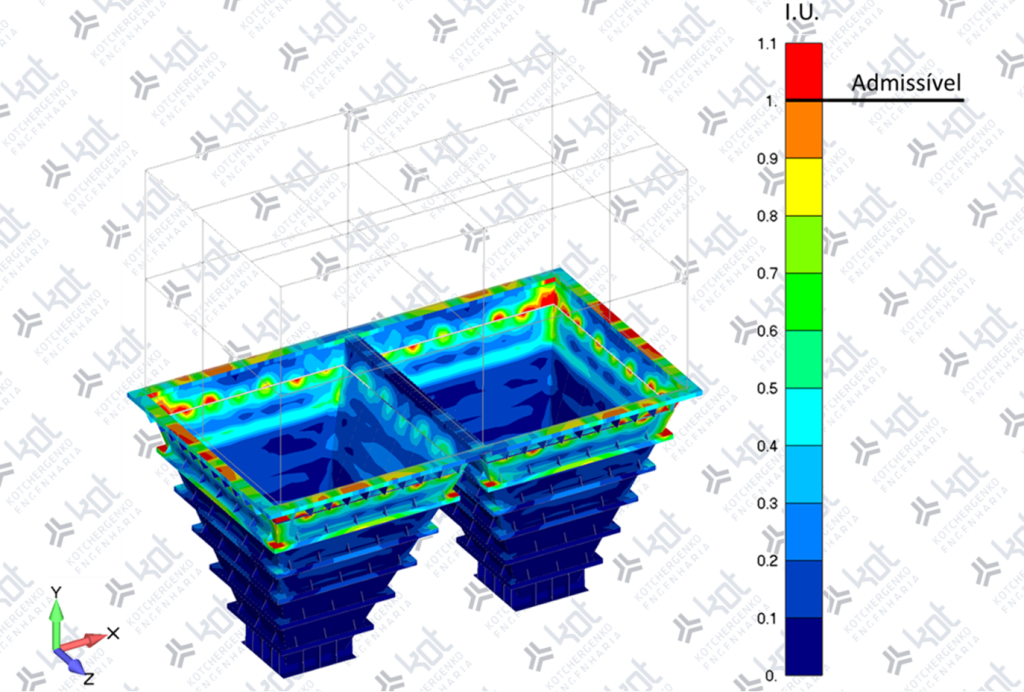
When a non-conformity occurs, the risk of failure is greater than desired. As an example, the structural non-conformities of a piece of equipment are highlighted as dots and areas in red in Figure 5, which represent stresses above the admissible ones according to the structural assessment carried out.
In an ASD verification, this would be equivalent to a lower overall safety factor than recommended. In a limit state verification, this information would indicate that the probability of failure is greater than the maximum specified by the standard. In this sense, in relation to the LRFD method, it can be seen in the graph highlighted in Figure 6 that the pre-established quantile for action (increase factor) has a higher value than that adopted for resistance (decrease factor).
Therefore, even if the structure has not collapsed, the normative safety check may indicate non-compliance because, according to the standard, the risk of collapse is higher than desired. In other words, if a structure is non-compliant, even if this has not resulted in structural collapse, intervention in the structure is necessary in order to reduce the risk of failure.
Conclusion
In view of the concepts and methodologies presented in this article, the importance of structural safety becomes even more evident for the protection of assets and structures, as well as the safety and well-being of all the individuals involved.
Furthermore, by understanding the methodologies, applications and interpretations of this type of analysis, decision-making becomes even more assertive, obtaining satisfactory results in terms of quality, safety and productivity.
Structural Safety is with Kot Engenharia
If you, like our more than 150 clients, are looking for engineering solutions for structures for your operation,consult our teamandlearn about our services. Since 1993, we have been specialists in developing engineering solutions through inspections, technological tests, and the use of computational methods for complex evaluations of concrete and metal structures and industrial equipment.
Follow us onLinkedIn,Facebook, and Instagram and keep up with our content.
FAQ
1. O que é segurança estrutural e como ela se relaciona com capacidade e solicitação?
Segurança estrutural é a condição em que uma estrutura ou equipamento opera com o desempenho esperado, resistindo a todas as ações previstas com uma margem de folga adequada. Essa avaliação baseia-se na comparação entre duas grandezas fundamentais:
-
Capacidade (Resistência): É o esforço máximo que a estrutura suporta, considerando também o seu desempenho operacional e a sua durabilidade perante agentes agressivos do ambiente;
-
Solicitação (Carga): É o conjunto de todas as ações que exigem resposta da estrutura, englobando o peso próprio, forças ambientais (como vento e variação térmica), cargas operacionais dinâmicas e eventuais ações extraordinárias (como impactos).
2. Qual é a diferença prática entre o Método ASD e o Método LRFD (Estados Limites)?
A principal diferença está na forma de tratar as incertezas e os riscos de falha do ativo:
-
Método ASD (Allowable Stress Design): Aplica um único fator de segurança global sobre a resistência do material, comparando-a com as solicitações nominais esperadas. É um método tradicional baseado na experiência histórica, mas sem fundamentação probabilística rigorosa, o que o levou ao desuso nas normas modernas;
-
Método LRFD (Load and Resistance Factor Design): Utiliza ferramentas estatísticas para aplicar fatores parciais que majoram as cargas e minoram a resistência do material. Isso permite garantir uma probabilidade de falha pré-conhecida e controlada para diferentes tipos de materiais e combinações de carregamento.
3. Qual é a diferença entre Estado Limite Último (ELU) e Estado Limite de Serviço (ELS)?
A distinção reside na gravidade e no tipo de comprometimento da estrutura:
-
Estados Limites Últimos (ELU): Estão diretamente relacionados à segurança e à resistência mecânica. Quando atingidos, exigem a interrupção da operação, pois representam risco imediato à integridade física, como colapso por ruptura, perda de equilíbrio de corpo rígido, instabilidade por flambagem ou falha dinâmica;
-
Estados Limites de Serviço (ELS): Estão associados à durabilidade, ao conforto e à funcionalidade da estrutura. Seus limites não indicam falha estrutural iminente, mas representam não conformidades operacionais, como vibrações desconfortáveis, fissurações excessivas ou deformações que prejudicam a operação de máquinas e o escoamento de água.
4. Uma estrutura em situação de não conformidade estrutural está prestes a colapsar?
Não necessariamente. A verificação de não conformidade significa que a margem de segurança exigida pelas normas técnicas foi ultrapassada — ou seja, no método ASD, o fator de segurança ficou abaixo do recomendado; no método LRFD, a probabilidade de falha tornou-se maior do que a tolerada. Embora o colapso não seja instantâneo, a não conformidade sinaliza que o risco operacional é inaceitável, exigindo intervenções imediatas (como reforços estruturais ou limitação de carga) para restabelecer os níveis normativos de segurança.
5. Quais são as principais normas da ABNT para cálculo e avaliação de segurança estrutural no Brasil?
As principais normas técnicas nacionais que norteiam a segurança e o dimensionamento estrutural incluem:
-
ABNT NBR 8681: Estabelece os critérios para ações e segurança nas estruturas, definindo os fatores parciais e as combinações de carga;
-
ABNT NBR 6118: Regulamenta o projeto e a execução de estruturas de concreto armado e protendido;
-
ABNT NBR 8800: Focada no projeto de estruturas de aço e mistas de aço e concreto para edifícios;
-
ABNT NBR 7190: Define as diretrizes para o dimensionamento e projeto de estruturas de madeira.
6. Quais cuidados devem ser tomados ao interpretar resultados emitidos por softwares de engenharia estrutural?
Softwares de cálculo estrutural automatizam operações complexas e reduzem erros no cálculo da resistência dos materiais, porém exigem análise crítica do engenheiro responsável. Na interpretação dos resultados, deve-se verificar:
-
Validação das Cargas: Se os valores das ações solicitantes inseridos no programa correspondem à realidade operacional e às combinações normativas corretas (diferenciando cenários de construção, operação e manutenção);
-
Fatores de Segurança Utilizados: Se a metodologia do software alinha-se com as normas vigentes do país e se os fatores parciais de majoração/minoração foram configurados adequadamente;
-
Análise de Todas as Etapas: Garantir que o modelo tenha considerado situações temporárias críticas, como fases de içamento de peças ou elevação hidráulica para substituição de aparelhos de apoio.