When a vessel collision critically damaged three prestressed concrete piers on the access bridge to a port pier, Kot Engenharia called upon to design a highly complex emergency repair solution. Operating in a harsh marine environment and without interrupting the belt conveyor’s operations on the deck, the project involved daily topographic monitoring integrated with finite element models (FEM), a novel mechanical jacking system monitored in real time via a mobile app, and the installation of new redundant piles with permanent metal casings and submerged concrete. The result restored the Structural Integrity with absolute safety and without any operational downtime.
Want to find out how highly complex engineering solved this partial collapse in the open sea? Read the full article!
1. What should be done when a structure suffers partial collapse due to a collision and rapid action is required for its recovery?
In this article, you will understand how well-done and rigorous technical work, combined with studied and customized engineering solutions, can transform a structure with compromised elements into a safe and reliable asset. So, follow the steps taken for efficient structural recovery in the text below and learn about the challenges and lessons learned from this successful case.
The subject of this article is an access bridge to a port pier. It is a structure that dominates the landscape and has recently undergone structural restoration.
In the historical context of the project, the access bridge was built almost 20 years ago. At the time of construction, Kot Engenharia the company responsible for calculating the loads acting on the infrastructure due to the pile driving system. For this, heavy equipment called CantiTraveler was used. As a result, this device was successfully employed in the project, providing agility and quality to the venture. Finally, a photo of the asset in question can be seen in Figure 1.
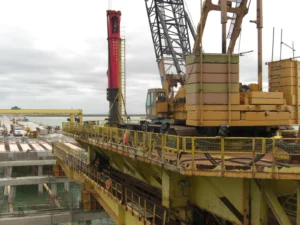
Figure 1 – Access bridge to the pier during construction – Kot was the company responsible for calculating the loads acting during the pile driving process using Cantitraveler.
2. Exposure to maritime risks and collision damage
The access bridge is a grandiose structure, with 80% of its length over the sea, and the ocean's weather conditions directly affect its structures. In other words, in practice, it is an offshore structure. In this context, the waves and currents are strongly influenced by a river located near the port, which adds a high level of risk severity to the structure.
Furthermore, in rough sea conditions, it is not uncommon for vessels anchored in the region to drag – nautical term for when the anchor drags on the bottom (the vessel) – due to the current or wind. Consequently, vessels may collide with the bridge's foundation structures, and even with the superstructure. However, this depends on the size of the vessel, although the latter condition is rarer due to the restrictions imposed by the Port Authority on navigation in the region.
Thus, severe damage to concrete structures can occur in the event of a collision with a vessel. Due to the partially brittle behavior of concrete, its energy absorption capacity is limited, which can cause damage to the material. In such cases, strong waves and currents contribute to intensifying the loads caused by collisions. Therefore, the use of elastomeric fenders in this type of structure is essential, but due to their length, it is practically unfeasible economically to adopt this system throughout the entire project.
One of the collision events resulted in irreversible damage to three access bridge pipes in the area where they are attached to the transverse deck support beam. The severe damage can be seen in Figure 2.
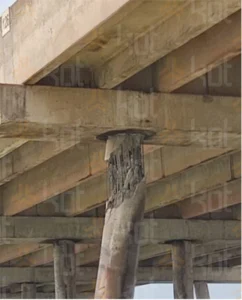
Figure 2 – Damage observed on the access bridge pier due to a collision with a vessel.
The bridge's tubes are 800 mm in diameter with tubular geometry and are made of prestressed concrete. With the damage to the infrastructure elements, the crossbeam was left hanging, and, due to the design dimensions, it did not collapse, keeping the deck stable.
3. Measures for safe intervention
Kot was responsible for the structural restoration of the bridge, with support from another company that is a technical reference in bridge maintenance and restoration in Brazil. Kot was responsible for the calculations and design of the stabilization and load transfer system, while the partner company was responsible for specifying and preparing the procedures related to the restoration of reinforced concrete and prestressed concrete structures. Finally, a third company contracted directly by the end customer carried out the structural restoration work.
4. Structural Monitoring planning to ensure safety during interventions
Initially, before any intervention that could put people at risk, a method was established for topographic monitoring of the bridge's movements in order to verify its stability on a daily basis, especially with regard to the vertical movements of the crossbeams and the vertical and horizontal movements of the damaged stations. In addition, a finite element model was developed, which served as a reference for calculating displacements before and after the accident, allowing comparison and subsequent validation with topographic measurements.
However, due to the damage caused by the collision, the foundation stations completely lost their ability to support the crossbeam, completely altering its bending moment diagram. The change in the structural configuration of the parts was so significant that their vertical displacement increased by about 24 mm, as shown in Figure 3. After about a week of topographic monitoring and with the bridge stabilized, the structural recovery sequence began. The condition of the crossbeam after the collision can be seen in Figure 4.
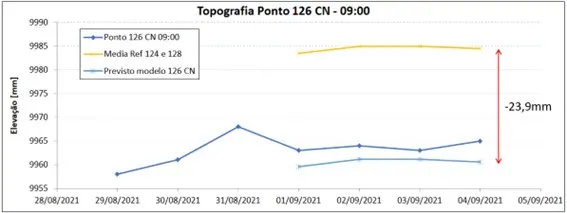
Figure 3 – Topographic monitoring of the bridge, a resource used to certify stability and safety for the start of restoration work.
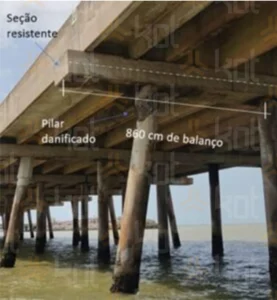
Figure 4—Condition of the bridge girder after the collision; damage to the pile caused a substantial change in the stress diagram of the component.
Finally, once an appropriate sequence of interventions had been defined to ensure total safety for construction workers and bridge users, all operations were carried out with the belt conveyor operating on the bridge in operation, without the need to interrupt the client's activities.
5. Load stabilization and transfer system
Initially, a mechanical system for locking and stabilizing the structures was developed, inspired by the locking mechanisms used during the construction of the bridge. The design was ingenious and included devices to support hydraulic cylinders and enable the second phase of the restoration work.
The developed pile locking and stabilization system can be seen in Figure 5.
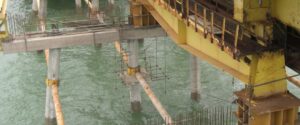
Figure 5 – The developed pile locking and stabilization system was fundamental to the success of the structural recovery.
With the locking devices installed, the necessary stabilization condition was achieved. The deck was then raised to its original height using high-capacity hydraulic cylinders. In addition, the station's resistance was mobilized below the damage area to react to the lifting forces.
In addition, the lifting system was supplied by a partner company specializing in the movement of large loads. Finally, the cylinder pressure monitoring system developed by Kot was also used, allowing the structure lifting process to be monitored in real time via an Android app.
6. Structural recovery
With the load transfer phase successfully completed, the damaged station structures were recovered in complete safety. Since there can be no doubt about Structural Integrity bridge foundations and large structures, structural reinforcements were designed, as there are no methods capable of unequivocally certifying the integrity of the affected foundation elements, especially in the soil-structure interaction regions.
In this sense, for the dimensioning of the reinforcements, the contribution of the damaged stations was disregarded, even after their recovery. This design decision adds structural redundancy and ensures the success of the recovery.
Therefore, the solution adopted consisted of driving two new piles per axis, joined by a longitudinal crossbeam. Thus, the new piles were concreted with lost metal sleeves and the submerged concrete technique, under the technological control of a partner company in this challenge.
In addition, prestressed concrete was used to connect the new piles to the existing reinforced crossbeam, with steel cables running the entire length of the crossbeam. The conditions for raising the end of the crossbeam were determined based on finite element models developed by Kot. The end of the crossbeam was raised in a controlled manner using hydraulic cylinders, ensuring the transfer of loads from the crossbeam to the new foundation elements.
The final situation of the structure after recovery is shown in Figure 6.
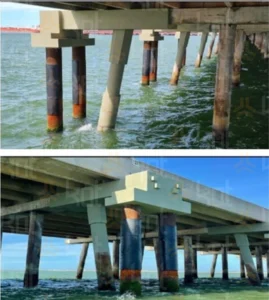
Figure 6 – Final condition of the structure after restoration, which involved driving two new piles. The connection to the existing structure was made using prestressed concrete.
7. Practical aspects of the work
One highlight was the use of the QuickDeck System to build access points, which added safety and practicality. In ocean regions, constant support from small boats is necessary for rescues in case of falls into the sea.
In addition, all the fastening was carried out from the top of the bridge deck, with the aid of cranes. However, the use of barges with cranes was not feasible due to the severe sea conditions, where strong winds, waves, and currents prevented the equipment from stabilizing.
It was decided to install the cranes on the deck, which caused some interference with vehicle traffic. However, with diversion and control measures, the impacts were minimized without compromising operations.
8. Lessons from the structural restoration of the bridge
Interventions on offshore structures, such as this bridge repair, represent a technical challenge. Planning must take seasonality into account in order to take advantage of periods of better weather conditions. However, in emergency cases, such as collisions, there is not always time to wait, requiring creativity and appropriate equipment.
Therefore, managers of large structures must take care of the asset, in addition to acting with an obligation to reduce the risk of further damage, especially when there is a periculum in mora. Inaction may even result in insurance companies refusing to provide coverage. In this regard, the immediate stabilization of the bridge was decisive in preventing further damage and maintaining operations.
The structural capacity of the crossbeam was also a very important factor in the success of the recovery, as even with the loss of a support pile, it was able to keep the deck stable without breaking. This design premise can be defined for new offshore projects, namely, the consideration that concrete parts cannot break if the outermost support, which is the most susceptible to a vessel collision, is eliminated.
Finally, the use of safe and easy-to-install access points was fundamental to the success of the restoration work. In addition to providing safe conditions for workers, the existence of spacious access points allows for more effective supervision of the work, enabling better access for the transport of equipment and tools for execution.
Structural Calculation is with Kot Engenharia
If you, like our more than 150 clients, are looking for specialized solutions in structural analysis or failure prevention such as deformation, vibration, and corrosion, consult our team and count on Kot Engenharia.
Since 1993, we have been offering engineering consultancy services through technical studies using non-destructive testing, field instrumentation and computer simulations (FEM, DEM and CFD) for highly complex diagnoses of concrete and metal structures and industrial equipment.
Follow our pages on LinkedIn, Facebook and Instagram and keep up with our content.
FAQ
1. How can we ensure the structural safety of marine bridges after high-impact collisions?
The safety protocol requires continuous topographic monitoring (to check for vertical and horizontal displacements) combined with finite element models (FEM) to recalculate the new stress diagrams. In submerged prestressed concrete elements, impacts generate internal microcracks that are invisible to standard testing methods. Therefore, the best engineering practice—adopted by Kot in this case—is to completely disregard the load-bearing capacity of the impacted elements when calculating the final reinforcement, ensuring full redundancy through new piles.
2. What is the limit for hydraulic lifting (jacking) on bridges in service?
The limit is determined by the maximum elastic deformation that the superstructure and installed equipment (such as train tracks or conveyor belts) can withstand without sustaining damage or misalignment. In the case of the offshore bridge assessed by Kot, the loss of support caused a displacement of 24 mm. The hoisting was performed in stages, using digital pressure sensors monitored in real time to ensure that the forces remained strictly within the safe margin calculated by the computational model.
3. Why is driving piles from a barge preferable in open water?
In offshore regions with severe winds and currents, stabilizing barges equipped with cranes becomes impractical and dangerous. Operating the cranes directly on the bridge deck eliminates tidal sway and ensures millimeter-level precision in the installation of the new foundations. To cast these piles underwater, the submerged concrete technique with a permanent metal casing is used, which prevents the concrete from being washed away by currents and protects the structure against salt corrosion.