The integrity of port structures is essential to promote safe mooring of vessels, and for this reason, the use of fenders is very important and strongly recommended. Read on Kot Engenharia learn Kot Engenharia the analysis conducted by Kot Engenharia minimize damage and increase port protection during mooring operations.
1. The problem of mooring vessels
The use of high-capacity ships for transporting commodities is becoming increasingly common. For example, there are large bulk carriers, with those in the VALEMAX class designed in 2010 being the largest, with a capacity of 400,000 tons. By comparison, a Capesize ship from the 1970s carries 170,000 tons, meaning that VALEMAX class ships are about 2.3 times larger. Figure 1 shows a relative comparison of ship sizes:
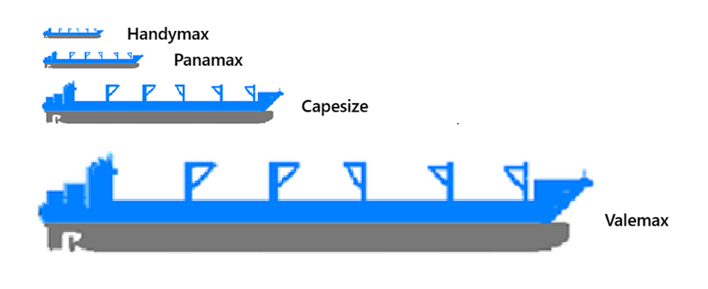
Figure 1 - Schematic relative size of the various ship classes [Source: Kot Engenharia]
Such a capacity and size of vessels results in a challenge for the port infrastructure, which needs to accommodate these ships safely in its berths.
The process of maneuvering the ship in port is carried out by a specialized professional, the Pilot, who has the necessary knowledge of port conditions such as currents, tidal behavior, wind, access channels, submerged obstructions, among other navigation risks. Thus, the entire operation is carried out under the Pilot's commands, from maneuvering the mooring point to entering the port and final docking at the berth.
2. Mooring charges
The loads acting during docking are very high and proportional to the displacement of the ship. Therefore, with the notable increase in the displacement of vessels in recent years, fenders must be capable of withstanding the energy involved in the docking process, preserving the infrastructure of the berths, most of which are made of reinforced concrete.
There are several parameters involved in calculating the loads acting during mooring, the main one being the normal component of the mooring speed, Vb. The mooring speed depends on the size of the ship, wave and current conditions, wind, and possible approach restrictions at the berth. The approach speed can be estimated according to BS6349, PIANC, among other standards, which adopt Brolsma curves. This curve is based on different approach and protection conditions of the port in question, which vary from 1 to 5, or from 'a' to 'e' in some specialized literature.
(a) Easy mooring, protected area;
(b) Difficult mooring, protected area;
(c) Easy mooring, unprotected area;
(d) Good mooring, unprotected area;
(e) Difficult mooring, unprotected area.
All the mooring energy must be borne by the fender located at the point of impact. Figure 2 shows some of the parameters involved in calculating mooring loads:
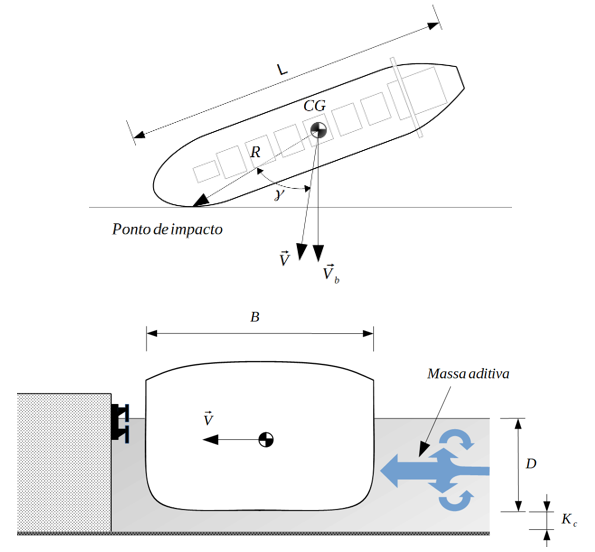
Figure 2 - Some of the parameters involved in calculating mooring loads. [Source: Kot Engenharia]
An interesting aspect of the mooring process is the watercushion that forms between the side of the vessel and the wall(water cushion effect). During mooring, the movement of water in this area can cushion the loads acting on the process. In some cases, the breakwater is hollowed out due to the pier's piling structures, which allows water to flow between the submerged foundation structures, reducing the water cushion effect.
Fender structures are typically made up of steel structures with elastomers attached to the slabs of the mooring pier.
The fender's main function is to absorb the ship's kinetic energy during the approach, converting it into the elastomer's deformation energy. Some of the energy absorbed in the process is dissipated through hysteresis and heat. Figure 3 shows a graph of the relationship between deflection, reaction and energy absorption in an impact absorption system:
![Relationship between reaction force, deflection and absorbed energy for a typical elastomeric fender [Source: Trelleborg].](https://kotengenharia.com.br/wp-content/uploads/2025/04/Imagem3.png.webp)
Figure 3 - Relationship between reaction force, deflection and absorbed energy for a typical elastomeric fender [Source: Trelleborg]
3. Examples of fender structures
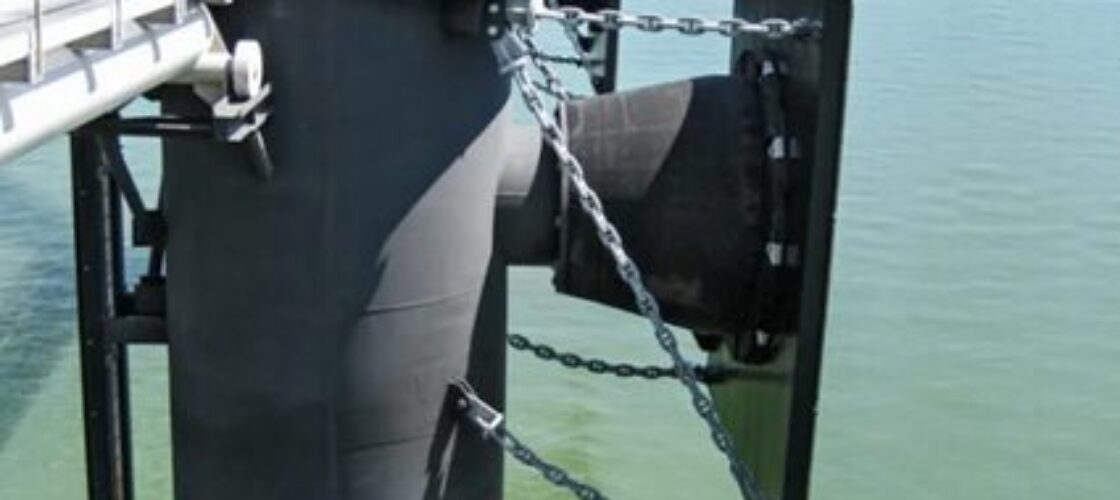
Fenders are usually made of elastomers, cylindrical or conical in shape. The elastomeric devices are attached to metal structures coated with polymers to reduce friction with the side of the boat. See Figures 4, 5, 6 and 7 for some examples of fenders.
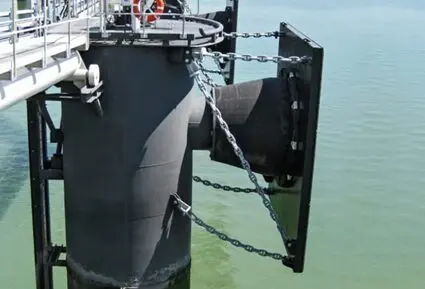
Figure 4 - Example of a pier SUPERCONE fender fixed directly to the metal pile, note the chains to prevent excessive displacement which could damage the fender.
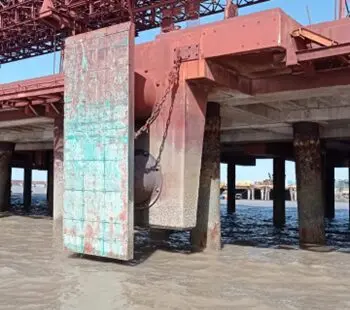
Figure 5 - Example of a pier fender in reinforced concrete and an elastomer fender with a metal panel.
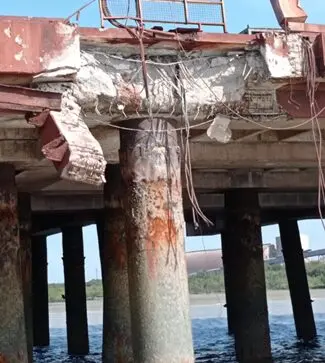
Figure 6 - Example of a pier damaged by an unsuccessful mooring, strong sea currents resulted in an excessive approach speed of the ship that exceeded the capacity of the fender.
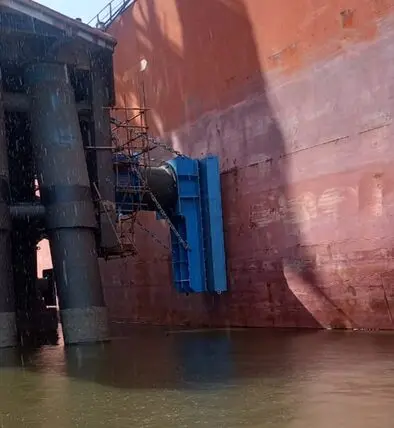
Figure 7 - Metal structure fender fitted with a cylindrical elastomer absorber; friction marks between the fender and the ship's side can be seen.
4. Final considerations
Elastomeric devices are fundamental parts of a port's infrastructure, preserving structures during ship berthing. An unsuccessful approach, for example, can result in damage to port infrastructure such as: piers, piles, walls, slabs, and can also cause damage to the ship's side structures. If the ship is damaged, the shipowner will charge for the necessary repairs, causing disputes that can be avoided.
The selection of the ideal fender must take into account the aspects of local port operations, because in less sheltered ports with obstructions and risks to navigation, the approach speed must be considered appropriately, directly influencing the energy capacity required for the fenders. The use of fenders with an energy capacity lower than that calculated is a risk, as berthing operations, even if carried out within the design conditions, could cause damage to port structures.
As the increase in ship capacity is a current reality, the port authority must be vigilant so that the fenders installed in its ports are suitable for the energy capacity required by these heavier vessels.
Security is with Kot Engenharia
If you, like our more than 150 clients, are looking for specialized solutions in structural analysis or the prevention of failures such as deformations, vibrations and corrosion, please contact our team and count on Kot Engenharia.
Since 1993, we have been offering engineering consultancy services through technical studies using non-destructive testing, field instrumentation and computer simulations (FEM, DEM and CFD) for highly complex diagnoses of concrete and metal structures and industrial equipment.
Follow our pages on LinkedIn, Facebook e Instagram and keep following our content.
FAQ
1. How does the increase in the size of modern ships directly impact the design of port structures and fenders?
Modern ships (such as the VALEMAX class) can be more than twice as large as the traditional bulk carriers of past decades. Since the kinetic energy involved in the approach is directly proportional to the vessel’s displacement (mass), the impact on the wharf has increased proportionally. If elastomeric fenders are not redesigned to absorb this greater amount of energy, the residual reaction forces will be transferred to the reinforced concrete infrastructure, causing serious damage to piles, slabs, and retaining walls.
2. What are the Brolsma curves, and why are they important in calculating a port’s mooring loads?
Brolsma curves are standard tools (adopted by international codes such as BS 6349 and PIANC) used to estimate a vessel’s normal approach speed ($V_b$) relative to the berth. They categorize mooring scenarios into different levels of difficulty and environmental exposure (ranging from fully sheltered areas where maneuvering is easy to unprotected regions with strong waves and winds). Identifying the correct curve ensures that the design kinetic energy reflects the actual severe conditions that the pilot will face during daily operations.
3. How does the “water cushion effect” work to absorb impact, and why does the type of pier affect this phenomenon?
The water cushion effect occurs when the water trapped between the ship’s side and the continuous wall of the pier (facing) is compressed during approach, acting as a natural hydraulic shock absorber that dissipates part of the kinetic energy. However, at open-spaced piers, supported on open piles, water flows easily through the submerged foundations. This reduces or eliminates the formation of this hydrodynamic cushion, requiring the fenders to absorb a much larger portion of the pure mechanical impact.
4. How do elastomeric fenders convert the ship’s kinetic energy, and what is the function of the polymer front panels?
The mechanical fender works by converting the vessel’s translational kinetic energy into elastic deformation energy within its elastomer block (typically in conical or cylindrical geometries). A substantial portion of this energy is permanently dissipated as heat due to hysteresis. To protect the integrity of the ship’s hull against tangential forces induced by motion, the fender uses front metal panels coated with high-density polymers, whose low coefficient of friction reduces wear caused by friction.
5. What are the main operational and legal consequences of failures in port defense systems?
If the defense system’s energy absorption capacity is less than the actual impact energy, the “end-of-travel” phenomenon occurs, transferring excessive reaction forces that damage the pier’s civil infrastructure and dent the ship’s hull plates. In addition to the costs of emergency repairs and the closure of the berth (which halts the flow of commodities), damage to the vessel results in heavy financial claims against the shipowner, leading to lengthy commercial disputes that could be avoided through preventive engineering audits and simulations.