Kot Engenharia responsible for measuring atypical loads on large wind turbines for one of its clients. To do this, a Digital Twin was developed to calculate loading conditions considered impossible or very difficult. In this context, if your company operates in the infrastructure, transportation, or large-scale construction sectors, keep reading to understand the importance of using this technology in your projects.
Introduction
The expansion of electricity generation through renewable sources is a topic of global interest. In Brazil, which has great onshore potential for wind power generation in the Northeast region, this expansion has been occurring in an even more special way.
In addition, the generation capacity of wind turbines has increased significantly over recent years, currently reaching values of around 6 MW per unit. Consequently, such high capacities present a major challenge for structural engineers involved in the design of this equipment. Therefore, advanced structural assessment techniques are necessary to ensure the operational safety of this type of asset. As an illustration, Figure 1 below shows a photograph of a wind turbine in operation.
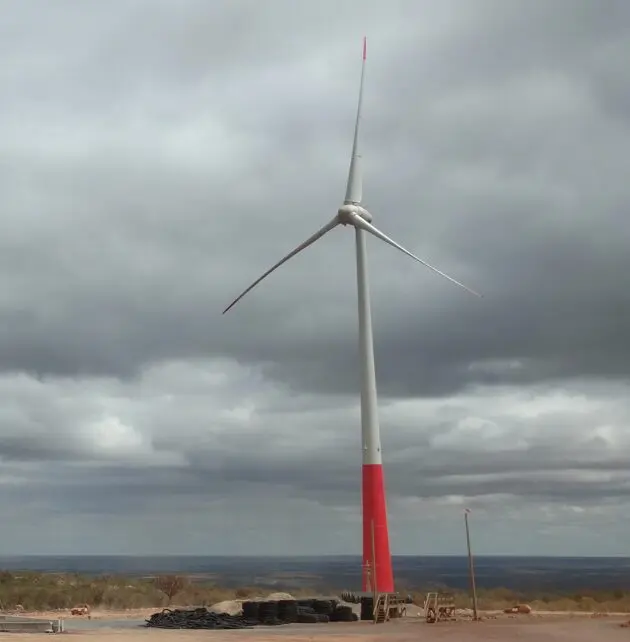
Figure 1: Image of a wind turbine in operation.
Therefore, it is essential to have accurate knowledge of the loads acting on the elements of this type of equipment in order to enable the correct dimensioning of the structures. This topic will be addressed below.
Loads acting on a wind turbine
This type of equipment is subject to wind, which generates forces in the same direction as the wind (alongwind) and transverse to the direction of the incident wind (crosswind), as shown in the following example in Figure 2.
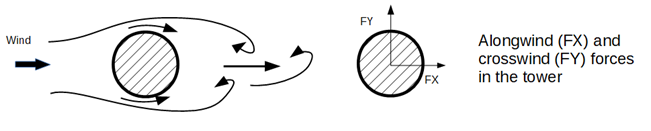
Figure 2: Forces caused by wind incidence on a wind turbine.
The drag load on the tower is distributed along the shaft and is directly related to wind speed. The loads acting on the wind turbine and tower generate bending moment stress along the shaft, so that the maximum bending moment occurs at the base of the tower, as can be seen below in Figure 3.
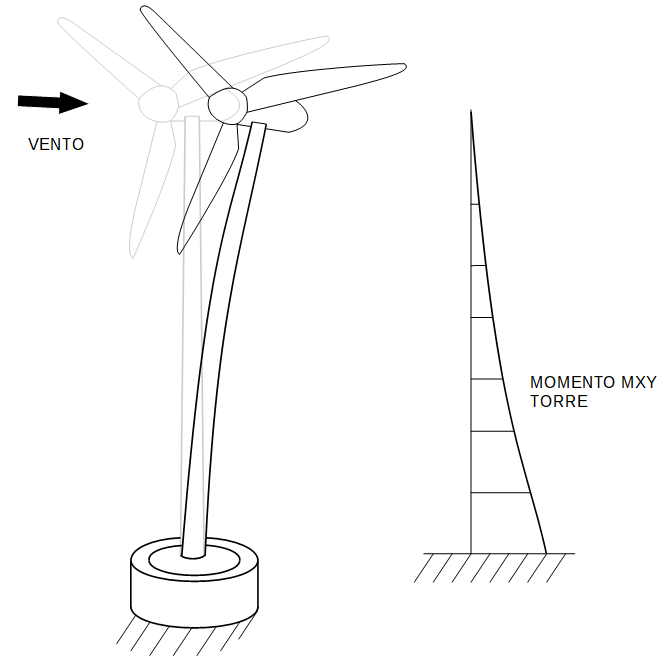
Figure 3: Bending moment acting on a wind turbine.
The main loads come from the wind turbine blades, which are inserted into the tower at the center line of the nacelle. The load generated is controlled by a system that acts on the angle of the blades, depending on the wind speed, given that this speed is a stochastic variable. According to the GL2010 standard, some operating parameters as a function of wind speed are defined in the graph below, in Figure 4.
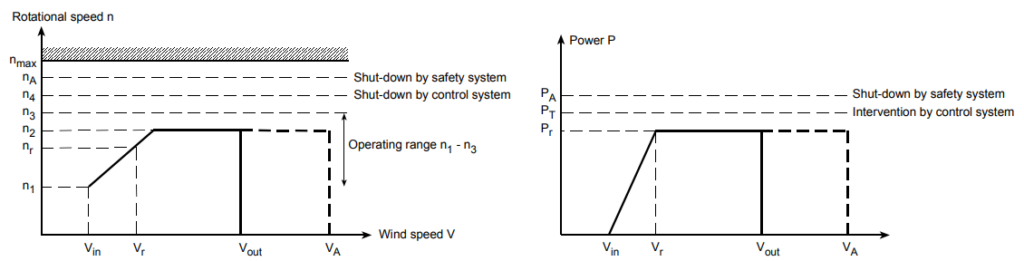
Figure 4: Operational parameters of wind turbines as a function of wind speed.
In one of the company's success stories, Kot installed sensors in wind turbines to measure actual loads, helping the customer verify whether the loads provided by the equipment manufacturer were adequate for the design. Conducting this type of study makes it possible to provide greater operational safety and adequate durability for the equipment.
The monitoring of these loads was carried out using equipment developed exclusively by Kot. In this case, as in many others, the customer's needs require on-demand solutions for structure monitoring.
The graph below (Figure 5) shows the temporal variation of the moment forces acting on the wind turbine tower over a period of 5 minutes.
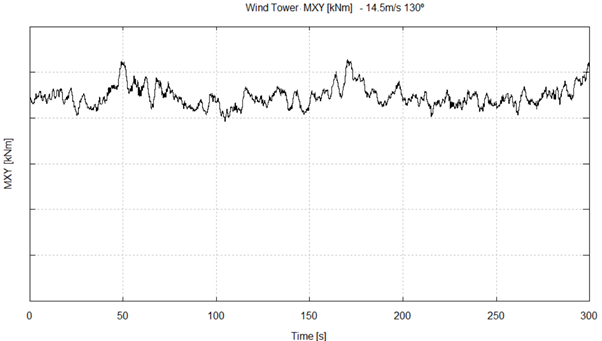
Figure 5: Moment forces acting on the wind turbine tower as a function of time.
At the end of the monitoring period, the data was processed, and a Digital Twin of the asset was developed using statistical analyses and engineering calculations. After characterizing the parameters of the Digital Twin, it was possible to calculate the forces acting under extreme loading conditions, which would be impossible or very difficult to measure on the physical asset.
One example is storm winds, which have a recurrence time of around 50 years, meaning they occur very rarely. It would be like winning the lottery to carry out instrumentation on a wind turbine and capture the structure being subjected to such a rare wind event.
Through the work carried out by Kot, fundamental data was obtained for the development and improvement of the equipment tower structure. It was possible to increase safety by using correctly dimensioned structures and also reduce costs by avoiding oversizing due to a lack of accurate information. If, like our more than 150 customers, you are looking for specialized engineering or failure prevention solutions, consultour teamand count on Kot Engenharia.
Since 1993, we have been offering engineering consultancy services through technical studies using non-destructive testing, field instrumentation and computer simulations (FEM, DEM and CFD) for highly complex diagnoses of concrete and metal structures and industrial equipment.
Follow our pages on LinkedIn, Facebook and Instagram and continue to follow our content.
FAQ
1. What are the main forces generated by the wind that act on a wind turbine tower?
The wind acting on a wind turbine generates forces in two main directions: forces in the same direction and sense as the incident wind (alongwind) and forces transverse to the wind direction (crosswind). The wind drag load is distributed along the entire length of the tower shaft, generating a cumulative bending moment whose maximum stress occurs exactly at the base of the structure.
2. How do the wind turbine blades affect the loads on the tower?
The main loads collected by the wind turbine blades are transmitted directly to the tower along the nacelle’s centerline. To mitigate and control the impact of these dynamic forces (since wind speed is a stochastic and unpredictable variable), wind turbines use a system that adjusts the angle of the blades in real time, based on operational parameters from reference standards such as GL2010.
3. Why monitor physical loads in the field if the manufacturer already provides this data?
Although manufacturers provide theoretical design data, conducting physical field measurements using custom instrumentation makes it possible to verify whether the actual loads acting on the structure correspond to the dimensional models provided. This verification ensures that the foundation and the steel structure operate within safe durability limits, preventing structural surprises or premature failures caused by environmental variations specific to the installation site.
4. How is a wind turbine’s digital twin developed, and what is its practical use?
The Digital Twin is developed based on the statistical and mathematical processing of real-time momentum and deformation data collected by physical sensors installed on the field asset. After characterizing these operational parameters and calibrating the numerical model, the simulation calculates the structure’s behavior and stresses under extreme loading conditions that would be difficult to measure physically on the actual asset.
5. What are low-frequency extreme loads, and why is the Digital Twin essential for evaluating them?
These are severe and atypical weather conditions, such as storm-force winds, with an estimated return period of around 50 years. Since the probability of recording an event of this magnitude during a temporary field instrumentation campaign is extremely low, the Digital Twin becomes indispensable. It simulates, with mathematical precision, the impact of these rare storms on the tower’s virtual model, ensuring that the physical structure can withstand extreme conditions without the need to oversize the materials.