
Basic concepts
Computer-Aided Engineering (CAE) [1] can, in fact, be defined as the use of a computer to improve or assist in engineering solutions or product development across a wide range of industries.
In this context, when the topic at hand is statistics, two types of variables stand out: continuous and discrete variables. In this article, learn how CAE and discrete variables are related and how they are applied in engineering.
First, understand the differences between continuous and discrete variables.
In general, it can be said that continuous variables are infinite, and there is always something between them. Discrete variables, on the other hand, are countable, and there are no elements between them [2]. To better understand these concepts in practice, see Figure 1.
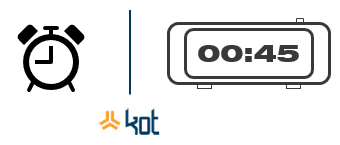
Figure 1: Analog clock (continuous variable) and digital clock (discrete variable)[3].
For example, when reading an analog clock, there are infinite possibilities, since it is not possible to specify the exact position of the hands. It is also clear that there is always something between one reading and the next. These characteristics make it a continuous variable.
On the other hand, the digital clock only has one reading at a time, so there is no reading between one hour and the next. These facts characterize it as a discrete variable.
Based on this, continuous and discrete models are then defined. In the former, the state of the system changes continuously over time, while in the latter, the state of the system changes only when an event occurs.
Queue Theory
In general, Queueing Theory uses mathematical techniques to study the flow of objects through a network of processes. Furthermore, this sequence of events involves more than one location and includes certain time and frequency constraints on the passage of items [4]. Consequently, these conditions give rise to waiting times between the processing of these objects.
In this regard, the goal of Queuing Theory is to develop mechanisms for predicting how a queuing system will behave [4]. Based on this forecast, proactive measures can then be taken to optimize processes and prevent potential bottlenecks.
Industry applications
In this context, to meet the needs of the industry as a whole, Kot Engenharia these and other concepts from statistics and mathematics, with the aid of CAE methods, to develop discrete-event simulations.
In short, discrete event simulations virtually emulate queuing scenarios. In these queues, the arrivals, processing or services and exits of the objects in question are evaluated [5].
Advantages and Limitations of Discrete Event Simulation
First, it is worth noting that most real-world systems are highly complex, making analytical evaluation impossible. Therefore, simulations can be used in such cases.
Similarly, the virtual environment of the simulation offers other advantages, such as the ability to evaluate and compare systems under specific conditions.
However, the main barrier to discrete event simulations is the high cost of the software available to run them.
Steps for carrying out Discrete Event Simulation [6]
-
- Model design: First, in this stage, the system must be studied in order to understand its specific characteristics, the objectives of the simulation, and the desired level of detail. It is also during this stage that the necessary data is collected;
-
- Model implementation: Next, the second stage of development involves the computational modeling of the system;
-
- Analysis of the model's results: Finally, the model is ready and is used to draw more accurate conclusions and make more informed decisions.
Analysis of a Coal Port
By way of example, the following section presents a case in which Kot conducted a discrete-event analysis of a coal export port. Throughout the process, the study covered everything from the receipt of the material by the railroad’s logistics operations, through transportation and stacking in the storage yards, to the subsequent retrieval of the material, transportation to the port, and loading onto ships.
As a result, based on the model created, it became possible to determine and quantify the utilization rate of the equipment at each stage of port operations. In addition, the models in question are shown in Figures 2 and 3.
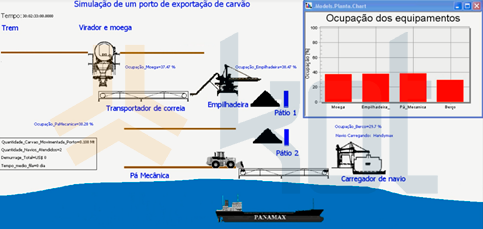
Figure 2: Model for studying a coal export port. [3]
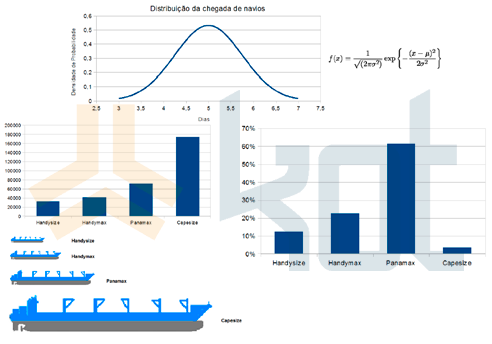
Figure 3: Modeling the ship queue - Gaussian distribution of ship arrivals, based on a known fleet provided by the shipowner[3].
The results of one year of operation, prior to the Kot study, can be seen in Figure 4.
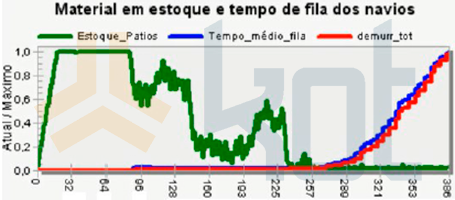
Figure 4: Plant results after 1 year of operation - see reduction in stock (green) and increase in demurrage costs (red). [3]
Based on the simulation results, problems were identified regarding the management of the port's inventory. As a result, Kot suggested some changes to the analyzed plan.
Subsequently, once these changes were implemented at the plant, a new simulation was conducted, confirming the effectiveness of the modifications and the port’s compliance with the handling capacity specified in the design. As a result, no additional investment in the plant was necessary; only process adjustments were required. The new simulation, with the suggested changes applied, is shown in Figure 5.
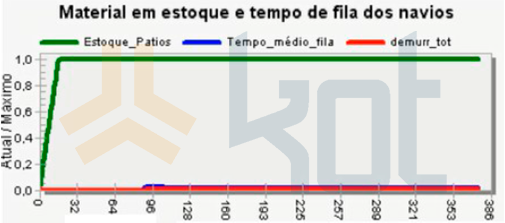
Figure 5: Maintaining stocks and reducing demurrage costs. [3]
Conclusion
In summary, by combining its expertise in mathematics and statistics with CAE methods, Kot Engenharia capable of conducting a comprehensive study of process systems, identifying potential bottlenecks, and suggesting modifications to optimize these processes. Kot can evaluate different processes and operations to help optimize results. Contact our team for more information!
Follow our pages on LinkedIn, Facebook e Instagram to keep up with our content.
FAQ
1. Qual é a diferença fundamental entre modelos contínuos e modelos discretos na simulação?
Nos modelos contínuos, o estado do sistema se altera de forma ininterrupta e suave em função do tempo (como o fluxo de um fluido em uma tubulação ou a variação do ponteiro de um relógio analógico). Já nos modelos discretos, o estado do sistema permanece constante até que ocorra um evento pontual (como a finalização do descarregamento de um vagão ou a mudança em um relógio digital), que provoca uma alteração instantânea nas variáveis de estado.
2. O que é a Teoria das Filas e qual a sua relação com a Simulação de Eventos Discretos?
A Teoria das Filas é o ramo da matemática e da estatística que estuda o comportamento do fluxo de recursos através de uma rede de processos com restrições de tempo, capacidade e frequência. A Simulação de Eventos Discretos utiliza os equacionamentos e distribuições de probabilidade da Teoria das Filas para emular computacionalmente a chegada, o tempo de atendimento (processamento) e a saída de materiais, permitindo prever a formação de gargalos em plantas industriais.
3. Quais são as etapas para a execução de uma Simulação de Eventos Discretos em engenharia?
O processo é dividido em três etapas fundamentais:
-
Concepção do modelo: Mapeamento detalhado da operação real, coleta de dados históricos de tempos/frequências e definição do nível de detalhamento do sistema;
-
Implementação do modelo: Construção do modelo virtual no software CAE, configurando as variáveis e regras operacionais;
-
Análise dos resultados: Execução de simulações de longo prazo para extrair indicadores (como taxa de ocupação de equipamentos) e fundamentar tomadas de decisão.
4. Quais são as principais vantagens e limitações da SED no setor industrial?
-
Vantagens: Permite avaliar sistemas reais altamente complexos que não possuem solução analítica simples, testando cenários alternativos (what-if) com total segurança e sem parar a operação fabril.
-
Limitações: O custo elevado das licenças de softwares especializados de CAE e a necessidade de mão de obra altamente qualificada em modelagem e estatística.
5. O que é demurrage e como a simulação ajudou a reduzi-la no case do porto de carvão?
Demurrage é a penalidade financeira cobrada pelo armador (proprietário do navio) quando o tempo de permanência da embarcação no porto para carregamento excede o prazo contratado. No case analisado, o porto sofria com estoques zerados nos pátios, gerando atrasos no embarque e longas filas de navios. A simulação computacional mapeou os gargalos da cadeia (da ferrovia ao pátio), permitindo readequar o fluxo de material e zerar os custos desnecessários de demurrage.
6. Por que a solução proposta para o porto de carvão não exigiu compra de novos equipamentos (CAPEX)?
A simulação demonstrou que a infraestrutura instalada no porto já possuía capacidade nominal suficiente para atender à demanda. O problema real estava na desorganização do fluxo de processos e no desequilíbrio do ritmo de chegada e recuperação do material. Ao ajustar o sequenciamento operacional e os estoques com base nos dados da simulação, a planta atingiu a produtividade desejada sem despender recursos em novos maquinários.
References:
[1] B. Raphael and I.F.C Smith - Fundamentals of Computer Aided Engineering
[2] Miller, J. (1988). Discrete and continuous models of human information processing: Theoretical distinctions and empirical results.
[3] Kot Engenharia Collection
[4] Newell, G.F.N - Applications of Queueing Theory
[5] Fishman, George S. - Discrete-Event Simulation: Modeling, Programming, and Analysis
[6] Chwif, L. and Medina, A. C. (2006). Modeling and simulation of discrete events. Afonso C. Medina.