In general, computational fluid dynamics (CFD ) is known for applying the finite volume method (FVM) to problems involving fluid flow, heat transfer, and other phenomena, based on concepts from numerical methods and thermofluid dynamics. The discrete element method (DEM), on the other hand, is applied when the goal is to analyze the displacements and rotations of discrete bodies. Before continuing, to understand the differences between the methods, check out this content in a previously published blog post. In this article, learn how Kot Engenharia both concepts in the analysis of an ore transfer system.
CFD-DEM analysis of an ore transfer system
First, a transfer chute is a component commonly found between conveyor belts that is used to direct the flow of material during the unloading process. In this context, a client company installed a new chute at its plant with the goal of reducing dust generation and emissions into the external environment. However, the new chute did not perform as expected, and Kot’s task was to identify the phenomena responsible for the generation and release of dust into the environment during the transfer of ore.
First, the behavior of the bulk material flow was analyzed using DEM in specialized software. As a result, it was concluded that there was no risk of clogging, as illustrated in Figure 1.
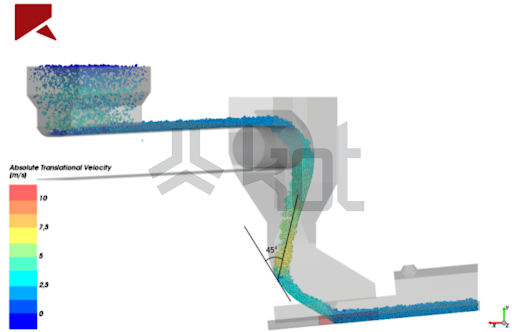
Figure 1: Material flow in the chute - SOURCE: Kot Collection.
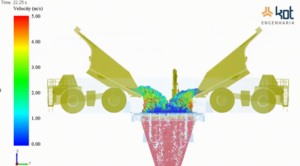
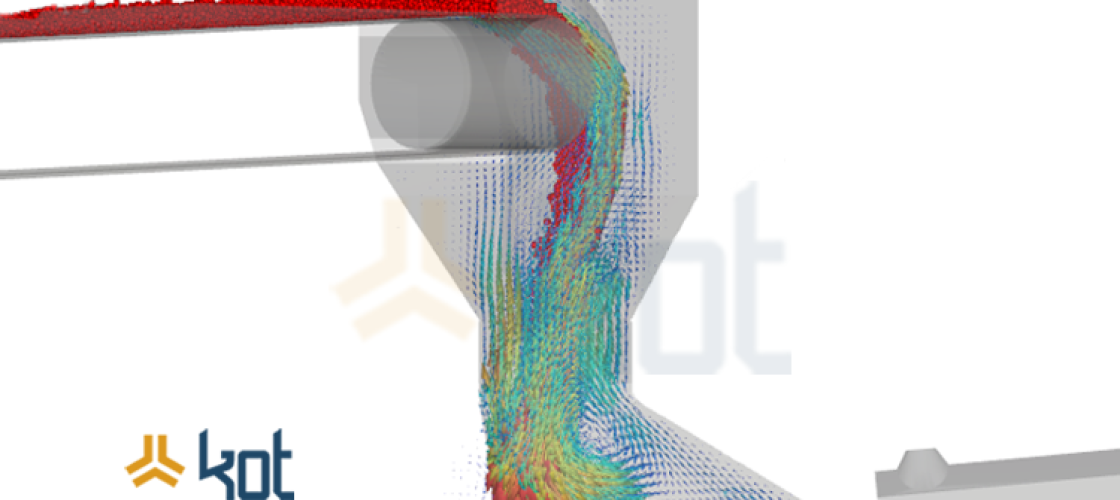
Next, the same software was used to couple CFD and DEM, with the aim of evaluating the airflow inside the chute. This made it possible to observe the formation of vortices in the inner region and a zone of high turbulence, which increases dust generation. These results are shown in Figure 2.
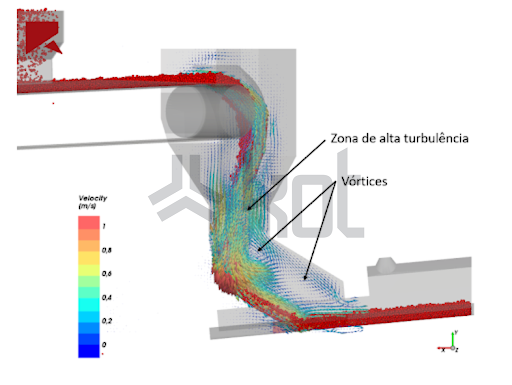
Figure 2: Air flow during kick discharge - SOURCE: Kot Collection.
In addition, to gain a more detailed understanding of the observed phenomenon, a study of the airflow in the material receiving conveyor was conducted. In this case, the conveyor has its own dust control system, which connects to the belt cover, which serves the same function. To this end, the analysis was performed using a computational fluid dynamics tool based on the FVM.
The results showed that the dust control system effectively fulfills its purpose. However, in the transition zone between the system and the conventional belt cover, factors conducive to dust generation were observed, since there is no enclosure. Vortex formation can be seen in Figure 3. On the other hand, at the outlet of the cover, it is evident that the phenomenon is mitigated.
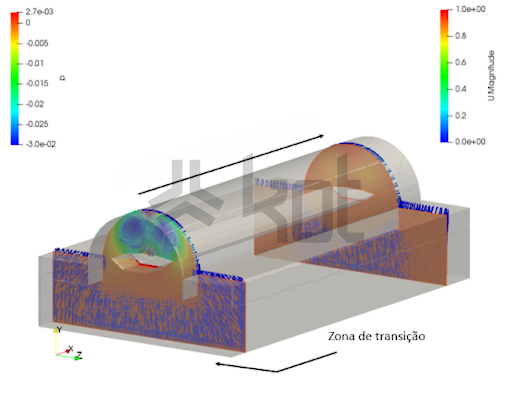
Figure 3: Cross-sections at the roof inlet and outlet - airflow pressures (P) and velocities (U) - SOURCE: Kot Collection.
In addition, the regions of turbulence along the conveyor’s covered area were analyzed, as shown in Figure 4, where the lines represent the airflow. Thus, it is evident, once again, that the transition region is the most critical point in terms of air currents.
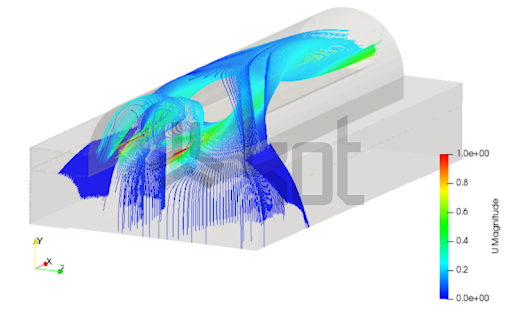
Figure 4: Air flow in the roof area - SOURCE: Kot Collection.
Consequently, the chute and the transition area between the dust control system and the cover are responsible for the high levels of dust generation and leakage. Based on the results, Kot Engenharia the causes of these problems and developed solutions, which involve geometric modifications to optimize the flow and methods to improve air recirculation.
Kot Engenharia has the experience and resources necessary to carry out simulations involving DEM and CFD analysis, such as the case described in this article. Contact our team for more information!
Follow our pages on LinkedIn, Facebook e Instagram to keep up with our content.
FAQ
1. O que é o acoplamento CFD-DEM e como ele funciona na indústria de granéis?
O acoplamento combina duas metodologias computacionais complementares para resolver problemas multifásicos (fases sólida e fluida simultâneas):
-
DEM (Discrete Element Method): Modela cada grão ou partícula sólida individualmente, calculando trajetórias, forças de contato, rotações e colisões.
-
CFD (Computational Fluid Dynamics): Resolve as equações de transporte de fluidos (ar) por meio do Método dos Volumes Finitos (FVM), calculando velocidade, pressão e turbulência.
Ao acoplar ambos, o software calcula como a queda do material sólido induz o arrasto do ar (pressurização) e como o fluxo turbulento do ar suspende e carrega as partículas finas de poeira.
2. O que é um chute de transferência e qual a sua importância no processo produtivo?
O chute de transferência é a estrutura responsável por guiar o fluxo de material a granel descartado por uma correia transportadora até a próxima etapa (outra correia, peneira ou moega). Seu projeto correto evita o impacto excessivo, o desgaste prematuro de revestimentos, o entupimento por acúmulo de material e a liberação de poeira no ambiente de trabalho.
3. Por que a análise isolada via DEM não foi suficiente para diagnosticar a fuga de poeira?
O método DEM isolado confirmou apenas que o fluxo de minério não causava entupimento na calha. No entanto, a poeira é constituída por partículas finíssimas que não seguem apenas a gravidade, mas sim as correntes de ar induzidas e a turbulência. Foi necessário introduzir o CFD para mapear a formação de vórtices de ar dentro do chute, que geravam pontos de alta pressão capazes de expelir o pó para fora da estrutura.
4. Qual a principal diferença entre os métodos CFD e DEM?
| Característica | CFD (Fluidodinâmica Computacional) | DEM (Método dos Elementos Discretos) |
| Foco de Análise | Fluidos contínuos (ar, água, óleos, gases) | Corpos e partículas sólidas discretas |
| Base Matemática | Método dos Volumes Finitos (FVM) | Dinâmica Newtoniana e Leis de Contato |
| Propriedades Avaliadas | Campos de pressão, velocidade, turbulência e temperatura | Posição, velocidade angular, forças de impacto e desgaste |
| Aplicação na Transferência | Fluxo e arrasto de ar dentro do chute e coberturas | Fluxo, entupimento e trajetória do minério |
5. Qual foi a causa raiz identificada para a emissão de poeira na região de transição?
Além dos vórtices internos no próprio chute, o estudo detalhado do transportador receptor mostrou que a região de transição entre o sistema específico de controle de poeira e a cobertura convencional da correia não possuía enclausuramento adequado. Essa abertura permitia que as correntes de ar altamente turbulentas escapassem para o meio externo antes que o fluxo se estabilizasse no trecho coberto.
6. Quais soluções engenheiradas foram propostas a partir dos resultados numéricos?
Com base nas regiões críticas identificadas pelas simulações, foram desenvolvidas:
-
Alterações geométricas no chute: Ajuste no perfil interno para suavizar a trajetória do material e reduzir a indução de correntes de ar;
-
Sistemas de recirculação: Redirecionamento do fluxo de ar interno para dissipar a energia cinética do ar e favorecer o assentamento das partículas em suspensão dentro do próprio compartimento.