It is commonplace in industry for unexpected phenomena to occur during operation: blockages, failures, poor distribution of material and loads, among others. In such cases, a costly solution would be to obtain new machinery. A structural assessment, on the other hand, is often a less costly solution, in which the problem is analyzed and modifications are proposed for the equipment already in the company's plant.
In this article, learn how Kot Engenharia applied structural engineering knowledge to propose solutions for silo operating conditions. If you are interested in learning about other Kot Engenharia success stories, click here.
Structural analysis of silo modifications
First and foremost, a silo is defined as a metal or concrete structure used for storing granular materials. It is usually part of a building complex that handles the loading and/or unloading of bulk materials.
Given this scenario, Kot conducted a structural assessment of silos at an industrial plant and identified a problem regarding access to these silos during operation due to material buildup. Consequently, possible solutions were proposed, including modifying the geometry of these assets so that the material would be better distributed. To verify the feasibility of the suggested modification, Kot performed a new structural analysis based on the finite element method.
First, we evaluated the possibilities for modifying the operating conditions so that the decrease in productivity would be as small as possible. Based on this, structural modifications were made, resulting in the model shown in Figure 1.
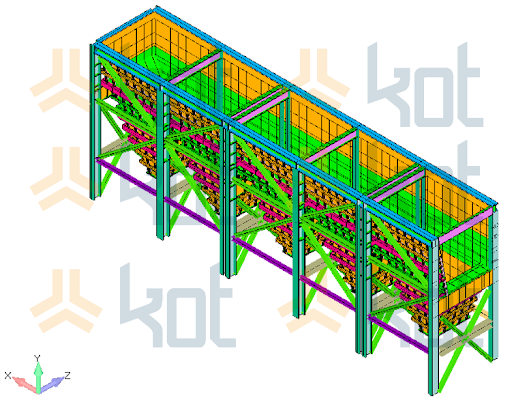
Figure 1: Finite element model of the silos after structural modifications. [1]
The asset then underwent different types of analysis, which will be explained in more detail below:
-
- Static Analysis:
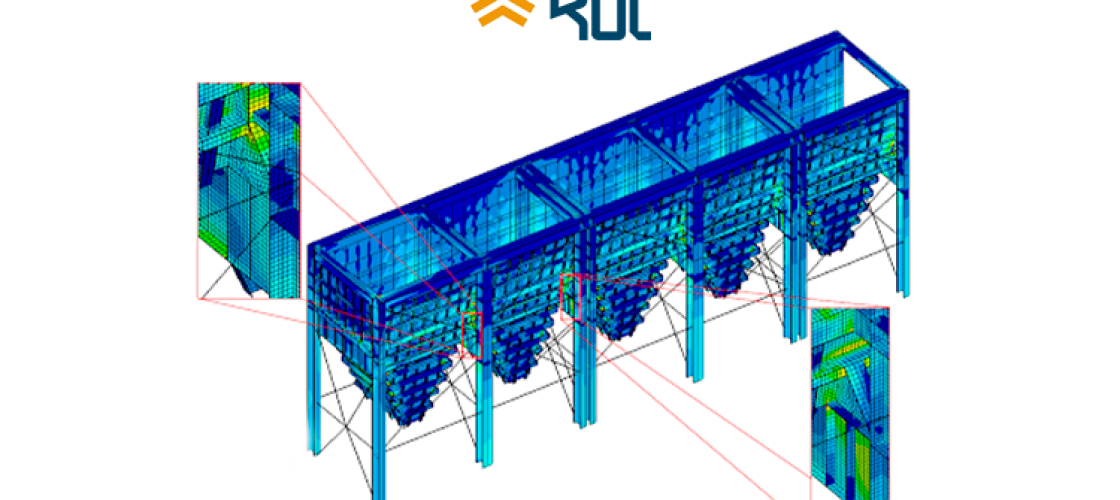
Primarily, it was used to perform the initial structural verification of the new geometry. Here, the stress acting on each element was indicated using a color scale, where red indicates values above the limits set by the standard. At this point, it became clear that reinforcements needed to be added to prevent localized stress concentrations in the structure. The final result is shown in Figure 2, where the structure is approved.
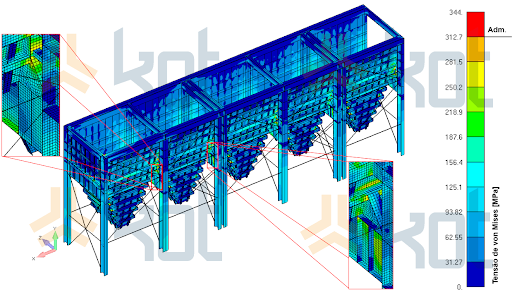
Figure 2: Result of the static analysis. [1]
-
- Fatigue Analysis:
Next, in this stage, the structure’s service life was determined based on the number of operating cycles, taking into account the profiles, plates, and metal connections of the silos. As a result, after reinforcement, the most critical region, shown in Figure 3, had a service life of 20 years, which is consistent with what is expected for this asset.
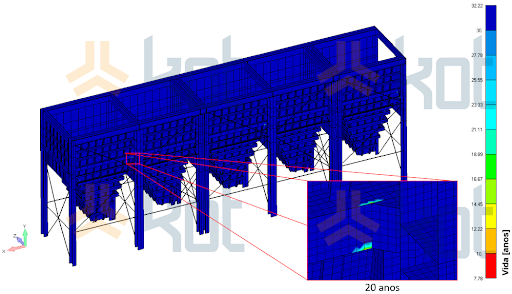
Figure 3: Fatigue analysis results. [1]
-
- Buckling Analysis:
Similarly, the buckling analysis used a linear approach to extract eigenvalues from the structure’s stiffness matrix. The eigenvalue is the ratio of the stress that would cause the element to buckle to the applied stress. Therefore, results greater than 1 indicate that the applied load is less than the element’s buckling load. Finally, the entire system yielded acceptable values in the analysis.
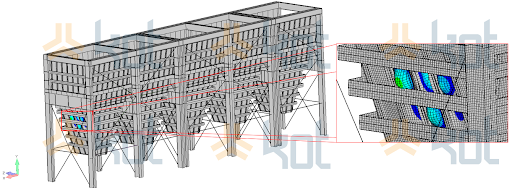
Figure 4: Result of wall buckling analysis. [1]
Subsequently, given the success of the modifications to the silos, the building in which they are located was analyzed under the new load conditions. The beam-column finite element model is shown in Figure 5.
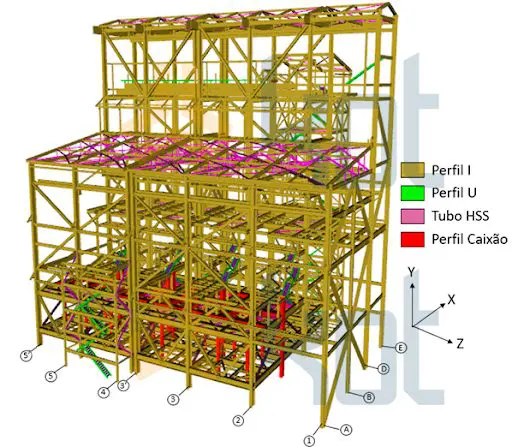
Figure 5: Finite element model of the building. [1]
-
- Superstructure analysis:
In addition, the analysis of the superstructure included a static check and an examination of the metal connections. This analysis identified the connections that should be modified in the silo supports, including the installation procedures and the necessary inspections in this case. The modified connections are shown in Figure 6.
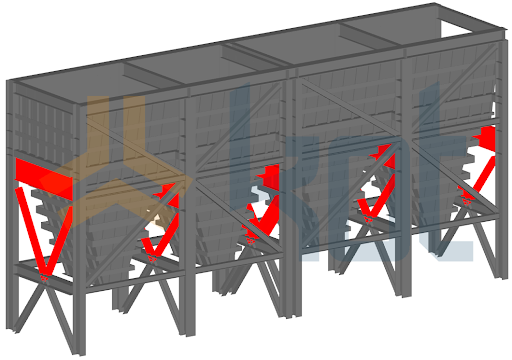
Figure 6: Altered connections on the silo support. [1]
-
- Flexibility Analysis:
In addition, the study included the base connections, where reinforcements were designed for regions of nonconformity. Therefore, the flexibility analysis examined the displacements in the region of the building’s main structure affected by the changes in silo loading, concluding that all values are less than the allowable displacements. Therefore, the silo modification has no impact on the structure’s compliance with its displacement service limit states.
-
- Civil Analysis
Finally, the infrastructure was analyzed. When checking the reinforced concrete radier foundation that supports the building's pillars, the calculated stresses did not exceed the permissible ones. The soil also showed sufficient resilience to withstand the stresses.
In short, reading this Succes story the importance of structural verification after modifications have been recommended for a given asset. This decision applies not only to the asset in question, but to the entire system of which it is a part. Carrying out installations and modifications before inspections, calculations, and simulations can result in choices that merely mask a nonconformity, and new problems may arise in the near future.
To understand which solutions should be applied to your assets, contact our team for more information!
Follow our pages on LinkedIn, Facebook e Instagram to keep up with our content.
FAQ
1. Por que a alteração geométrica e a reavaliação estrutural de silos são preferíveis à troca do equipamento?
A substituição completa de um silo industrial exige alto investimento financeiro e paradas prolongadas na planta. Na maioria dos casos de acúmulo de material ou bloqueio de fluxo, alterar a geometria interna ou dos chutes do silo existente é mais vantajoso. No entanto, alterar o formato do silo muda o padrão do fluxo de granel e a distribuição das pressões nas paredes, tornando a reavaliação estrutural por simulação computacional indispensável para evitar colapsos.
2. Quais foram as análises específicas realizadas na estrutura metálica do silo?
A validação da nova geometria do silo passou por três etapas principais de simulação via Método dos Elementos Finitos (MEF):
-
Análise Estática: Identificou pontos com altas concentrações de tensão (zonas vermelhas) para o dimensionamento preciso de reforços locais;
-
Análise de Fadiga: Avaliou a resistência dos perfis, chapas e soldas aos ciclos repetitivos de carregamento e descarregamento de granel, confirmando uma vida útil de 20 anos para a região mais crítica;
-
Análise de Flambagem Linear: Verificou a estabilidade elástica das chapas finas das paredes e pernas de suporte sob esforços de compressão.
3. Por que a modificação do silo exige a verificação do prédio que o suporta?
A alteração na geometria do silo e no volume de material armazenado redistribui as reações de apoio nas conexões com a estrutura do prédio. Se o prédio não for recalculado, o acréscimo local de esforço pode sobrecarregar vigas, colunas e ligações. A verificação da superestrutura garantiu a adequação das ligações metálicas de suporte e a definição dos procedimentos de soldagem/parafusagem e inspeção requeridos.
4. O que é a análise de flexibilidade e qual a sua importância para o projeto?
A análise de flexibilidade verifica se os deslocamentos e deformações da estrutura sob a nova condição de carga respeitam os Estados Limites de Serviço (ELS) estipulados pelas normas de engenharia. Ela garante que as deflexões nos pisos e passarelas do prédio não comprometam a operação de equipamentos vizinhos, tubulações rígidas ou o conforto dos operadores.
5. Como as fundações e o solo foram validados para o novo cenário operacional?
A engenharia realizou a verificação civil da infraestrutura, analisando o radier de concreto armado que recebe a carga dos pilares do prédio. Os momentos fletores e esforços cortantes solicitantes calculados pelo modelo de elementos finitos foram comparados com a taxa de armadura do radier e com a capacidade de carga admissível da pressão do solo, confirmando que ambos possuíam margem de segurança suficiente sem necessidade de intervenções civis profundas.
References:
[1] Kot Engenharia Collection.