Used in ore storage and homogenization yards—more commonly known as yard machines—these are large-scale assets of great importance to mining companies. This equipment is responsible for handling materials during construction or reclamation operations. Accordingly, this article discusses the company’s work on the stability analysis of an ore reclamation facility.
The Kot Blog has an expository text on the structural analysis of one of these machines and you can check it out here.
Introduction
In this regard, Kot undertook the task of analyzing a bucket wheel reclaimer. The equipment has been in operation since 2006 and handles iron ore at high capacity. During operation, the machine is capable of moving parallel to the material piles and also rotating around its own axis. In addition, the equipment features a boom capable of tilting vertically parallel to the height of the pile.
To this end, computational analyses were performed using FEM software. The three-dimensional computational model of the recovery unit is shown in Figure 1.
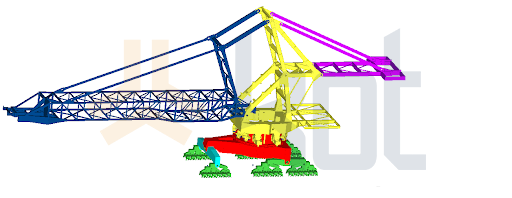
Figure 1: 3D finite element model of the reclaimer. [1]
First, a finite element model of the recovery unit was created. The machine’s structures composed of structural profiles were modeled as beam elements and statically verified in accordance with the recommendations set forth in the standard. Similarly, the other structures composed of structural plates were modeled as shell elements and evaluated according to international standard criteria. For example, some of the loads considered in the analysis are listed below.
-
- Weight of the metal structure and installed equipment;
-
- Loading material onto the belt conveyor;
-
- Dynamic effects of material transport on the belt;
-
- Overloading of stairs, walkways, platforms and roofs;
-
- Loads due to operating wind;
-
- Chute blockage.
Subsequently, after modeling, applying loads, and setting boundary conditions, the machine was evaluated from a structural standpoint. Further details on this analysis can be found in Succes story .
Case Study: Structural Analysis of an Ore Recovery Machine
Stability analysis
Global stability analysis consists of assessing the possibility of a machine tipping over. To do this, the stability safety index, defined by standard, is calculated for all combinations of loads and operating situations relevant to the study.
Two separate stability studies were conducted for the recycling machine: one considering only the rotating mass and the other considering the entire machine. The first analysis determined whether there was a risk that the anti-tip device would be activated, while the second analyzed the risk of the machine tipping over completely.
Figure 2 shows the stability polygon evaluated in the stability analysis of the upper part of the machine. Each edge of the polygon is considered a possible tipping axis that would trigger the anti-tip device.
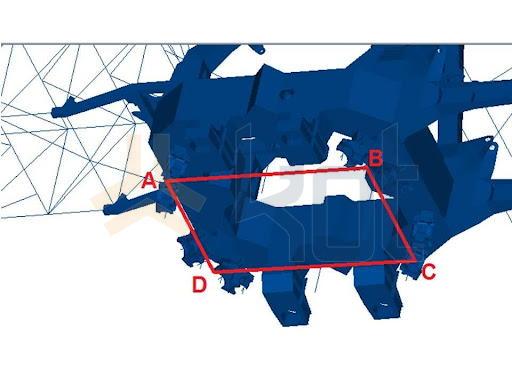
Figure 2: Stability polygon considered in the analysis of the rotating structure. [1]
Figure 3 illustrates the stability polygon evaluated in the stability analysis of the complete machine. Similarly, each edge is also considered a possible roll axis for the reclaimer.
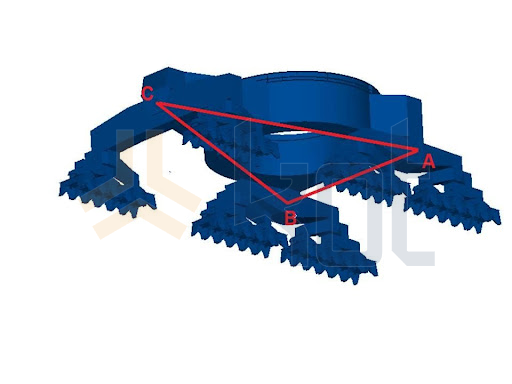
Figure 3: Stability polygon considered in the analysis of the complete reclaimer. [1]
In addition, in order to validate the results and the model created, Kot installed extensometers at various points in the equipment’s translational system. Next, after installing the sensors, the company’s team carried out a controlled operation, rotating the equipment to vary the loads on each leg of the gantry in order to measure the variations in deformation via extensometry.
Consequently, the results obtained in both stability analyses were positive, and the machine was approved from this standpoint. It should be noted that the analysis revealed that the anti-rollover system would not be activated, and in both analyses, all stress ratios found were below the safety factor.
In addition, the data obtained from the field instrumentation proved crucial for validating the study, as it was possible to determine the equipment's center of gravity with the aid of the finite element model.
Conclusion
In short, the stability analysis of yard machinery is an extremely important study for companies. After all, the overturning of such equipment can cause catastrophic accidents, resulting in fatalities, production downtime, and incalculable financial losses.
Kot has a great interest and a wide range of knowledge to study various engineering contexts. Contact our team for more information!
Follow our pages on LinkedIn, Facebook e Instagram to keep up with our content.
FAQ
1. Qual a função da recuperadora do tipo roda de caçamba no pátio de minério?
A recuperadora de minério é uma máquina de pátio de grande porte responsável pelo manuseio e recolhimento do material em pilhas de estocagem e homogeneização. O equipamento analisado atua no transporte de minério de ferro e realiza três movimentos principais: translação paralela às pilhas, giro em torno do próprio eixo e basculamento vertical da lança.
2. Como foi construído o modelo em elementos finitos (FEM) da máquina?
A modelagem tridimensional dividiu a estrutura de acordo com a geometria dos componentes:
-
Elementos de barra: Utilizados para representar os perfis estruturais da maquina;
-
Elementos de casca (shell): Utilizados para modelar as estruturas compostas por chapas metálicas.
Essa abordagem permitiu avaliar com precisão as tensões e os deslocamentos em cada trecho da estrutura de acordo com as normas internacionais.
3. Quais carregamentos operacionais e críticos foram considerados na simulação?
A simulação estrutural e de estabilidade submeteu o modelo a diversas combinações de cargas, incluindo:
-
Peso próprio da estrutura metálica e sistemas mecânicos/elétricos;
-
Carga de minério no transportador de correia e efeitos dinâmicos de transporte;
-
Sobrecarga em escadas, passarelas, plataformas e coberturas;
-
Cargas provocadas pelo vento de operação;
-
Eventos de entupimento de chute de transferência.
4. Como foram estruturados os dois estudos de estabilidade global?
O estudo abordou a estabilidade sob duas perspectivas complementares:
-
Análise da Estrutura Giratória (Massa Girante): Avaliou se as variações de carga na parte superior da máquina teriam capacidade de acionar o dispositivo mecânico antitombamento;
-
Análise da Máquina Completa: Avaliou o equilíbrio global de todo o equipamento (incluindo o portal de translação) para verificar o risco de tombamento geral da estrutura.
5. O que são os polígonos de estabilidade e qual seu papel na análise?
Os polígonos de estabilidade são representações geométricas onde cada aresta delimita um possível eixo de tombamento do equipamento. A análise computacional verifica se o vetor resultante de forças e a posição do Centro de Gravidade (CG) permanecem dentro das margens normativas de segurança em relação a cada um desses eixos durante todas as etapas do ciclo de operação.
6. De que maneira a extensometria de campo ajudou a validar a simulação?
A equipe instalou extensômetros no sistema de translação (pernas do portal) e realizou manobras comandadas de giro da máquina. A medição das variações de deformação real permitiu mapear as reações nos apoios sob diferentes ângulos da lança, sendo fundamental para calibrar o modelo computacional e determinar com precisão a posição do Centro de Gravidade (CG) do equipamento.
7. Quais foram as conclusões do estudo em relação à segurança do equipamento?
Os resultados de ambas as análises de estabilidade foram plenamente satisfatórios. Ficou demonstrado que o sistema de antitombamento não seria acionado sob condições operacionais previstas e que todos os índices de solicitação encontrados no modelo ficaram abaixo dos limites de segurança normativos, atestando a integridade do ativo.
References:
[1] Kot Engenharia Collection.