Introduction
SHM Structural Health Monitoring) can be defined as the process of implementing a strategy for characterizing and detecting damage to engineering structures, such as equipment, bridges, and buildings, for example.
Nesse contexto, o termo “dano” é definido como mudanças no material e/ou propriedades geométricas de um sistema estrutural, incluindo alterações nas condições de contorno, que podem, por sua vez, prejudicar seu desempenho.
O processo de SHM é realizado a partir de sensores (extensômetros, acelerômetros, termopares etc.), que auxiliam na observação contínua, durante determinados períodos, de diversos fatores que, ao serem somados permitem analisar o estado em tempo real da estrutura/equipamento monitorado. Além disso, estudar os dados obtidos, com toda a fundamentação teórica do setor da engenharia, é extremamente importante, pois somente com o conhecimento do domínio pode-se extrair características diretamente relacionadas aos danos e, por fim, desenvolver análises estatísticas para a determinação do real estado de saúde estrutural do sistema.
Historicamente, para máquinas rotativas, a análise e monitoramento de vibração de motores tem sido utilizada por décadas. No entanto, a análise de vibrações foi sempre utilizada de uma maneira isolada para fins de manutenção preditiva. A partir do momento da introdução de sensores e de técnicas que fazem uso de todos os dados para a construção de uma visão global, começou-se o desenvolvimento do que é conhecido, atualmente, como SHM.
Over the last two decades, SHM technologies SHM , creating new areas of research in different branches of engineering. However, what has contributed to greater possibilities for using the system has been the reduction in hardware costs (sensors, computers, and electronics) and improvements in networks and the internet. Conferences and scientific journals have emerged to specifically address the topic.
Ways to apply SHM
The SHM solution SHM focus solely on detecting faults, but also aims to establish an alert system to provide information on the fatigue and useful life of the asset being managed. SHM be used for long-term monitoring of road networks and bridges, as well as in catastrophic events such as earthquakes.
SHM a long-term focus
Over time, the effects of weather and degradation resulting from the operating environment to which the structure is exposed are inevitable. Therefore, SHM is expected to SHM whether the structure is still capable of performing the function for which it was designed. This understanding is obtained through periodic investigations and updates related to the structure.
SHM a focus on catastrophic events
Logo após eventos extremos e acidentes pontuais, como terremotos ou explosões, o SHM é utilizado para uma rápida inspeção das avarias e disponibilização de informações confiáveis sobre a integridade da estrutura, em tempo real. Além disso, essa rapidez possibilita tomadas de decisão mais assertivas, pois são baseadas em fatos e dados, além de evitar a exposição de trabalhadores ao risco da estrutura que pode ter sido severamente afetada.
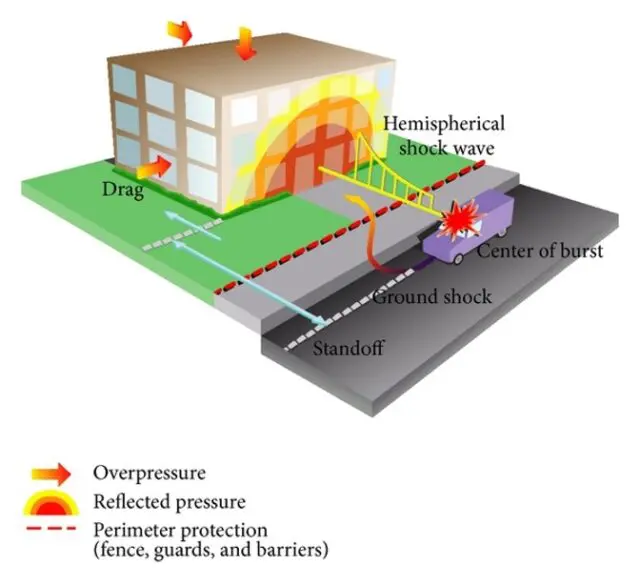
Figure 1: Diagram illustrating the loading on a building subjected to the shock wave resulting from an explosion - SOURCE: Smith, P., & Hetherington, J. 1994).
Industry 4.0
In recent years, industry in general (mining, steel and so on) has been undergoing a digital revolution with the evolution of its systems and technologies, which has become known as Industry 4.0. Mike Moore[4] briefly presents the concept of Industry 4.0 (or the fourth industrial revolution) on TechRadar:
"Industry 4.0 is the current automation of industrial and manufacturing practices through modern, intelligent technology. Large-scale machine-to-machine communication (M2M) and the Internet of Things (IoT) are integrated for greater automation, evolved communication and self-monitoring and the production of intelligent machines..."
In this context, without SHM systems and processes, SHM industrial plant could not be considered fully adequate for the future of Industry 4.0, reinforcing its competitive importance for large companies to remain prominent on the international stage.
Related to the concept of Industry 4.0, there is also the concept of Digital Twins, in which Artificial Intelligence, Machine Learning and CAE (Computer Aided Engineering) are integrated using the Finite Element Method to create living simulation digital twins that can update the virtual model according to events in the physical world.
It is therefore important to consider the participation of computer science and artificial intelligence in the advancement of engineering technologies. Industry is increasingly intertwined and dependent on their contributions, in terms of machine learning for diagnosis and classification of patterns in images and videos from industrial cameras.
In this sense, these applications have a clear impact on inspection and data collection contexts that can corroborate SHM system diagnostics and analyses, SHM until then were based solely on sensor data.
Por fim, mas não menos importante, ressalta-se a crescente necessidade de se analisar gigantescas quantidades de dados geradas pelos atuais sistemas de coleta de dados dos sistemas de monitoramento atuais.
Kot Engenharia in the domestic and international market with 27 years of experience, offering high-level technical engineering services to large companies. The activities carried out by Kot in recent decades in the areas of Structural Calculation, inspection, and monitoring qualify Kot to collaborate with your company in presenting this tool.
Kot Engenharia the experience and resources necessary to assess the need for and implementation of SHM Structural Health Monitoring) in your business assets. Consult our team for more information!
Follow our pages on LinkedIn, Facebook e Instagram to keep up with our content.
FAQ
1. O que é SHM e como a engenharia define o conceito de “dano” em uma estrutura?
O SHM é o processo sistemático de caracterização e detecção contínua de anomalias em ativos estruturais (pontes, prédios, máquinas de pátio, tubulações e estruturas offshore). No contexto da engenharia, um dano não se restringe a rupturas visíveis; ele é definido como qualquer alteração nas propriedades do material (como surgimento de trincas e perda de rigidez) ou nas propriedades geométricas da estrutura (deformações permanentes, folgas e alterações nas condições de contorno) que possam prejudicar o desempenho ou a segurança do sistema.
2. Quais são as duas principais formas de aplicação do SHM na gestão de ativos?
A aplicação das tecnologias de monitoramento divide-se em dois grandes focos operacionais:
| Abordagem de SHM | Objetivo Principal | Cenário de Aplicação |
| Foco em Longo Prazo | Avaliar a degradação progressiva do ativo decorrente de fadiga, intempéries e cargas operacionais contínuas. | Malhas viárias, pontes, galpões industriais e grandes equipamentos de mineração/siderurgia. |
| Foco em Eventos Catastróficos | Realizar inspeção e diagnóstico instantâneo logo após eventos acidentais ou extremos. | Terremotos, explosões, impactos de veículos ou sobrecargas operacionais severas. |
3. Como o SHM se integra aos pilares da Indústria 4.0?
A transição da manutenção preditiva tradicional para a Indústria 4.0 ocorre pela convergência de três frentes tecnológicas:
-
IoT e Sensores de Baixo Custo: Barateamento do hardware (extensômetros, acelerômetros, termopares) e disseminação de sensores sem fio, permitindo instrumentação densa de ativos;
-
Conectividade M2M e Redes de Altíssima Velocidade: Transmissão ininterrupta e direta de grandes volumes de dados de saúde estrutural entre máquinas e centrais de controle;
-
Big Data e Analytics: Capacidade de processar, armazenar e extrair inteligência técnica a partir do fluxo massivo de dados gerados $24/7$.
4. O que é um Digital Twin (Gêmeo Digital) no contexto do monitoramento estrutural?
Um Digital Twin é um modelo virtual de alta fidelidade da estrutura física que utiliza técnicas de CAE (Computer Aided Engineering) e o Método dos Elementos Finitos (MEF). Quando alimentado continuadamente pelos dados reais dos sensores de SHM, o Gêmeo Digital “ganha vida”: ele replica o estado de tensão, deformação e fadiga do ativo físico em tempo real, permitindo simular cenários operacionais futuros e prever falhas com precisão matemática.
5. Qual é o papel da Visão Computacional e do Aprendizado de Máquina (Machine Learning) no SHM moderno?
Além dos dados tradicionais coletados por sensores físicos (como vibração e deformação), o SHM da Indústria 4.0 incorpora câmeras industriais acopladas a algoritmos de Visão Computacional. Modelos de Machine Learning analisam imagens e vídeos de alta definição para:
-
Classificar e rastrear a propagação de trincas em superfícies de concreto e aço;
-
Detectar corrosão, desconexão de elementos e deformações visíveis;
-
Corroborar e validar os diagnósticos emitidos pelos sensores físicos instalados no ativo.
6. Por que uma planta industrial não pode ser considerada 100% alinhada à Indústria 4.0 sem o SHM?
A essência da Indústria 4.0 é a automação inteligente aliada ao automonitoramento. Sem um sistema de SHM estruturado, a planta fabril mantém pontos cegos em relação à integridade física do seu ativo principal. A ausência de monitoramento estrutural expõe a empresa a paradas catastróficas não planejadas, riscos de acidentes de trabalho e perdas financeiras — tornando o SHM um requisito de diferenciação e competitividade no cenário internacional.
References
[1]Mike Moore. TechRadar,2019.What is Industry 4.0? Everything you need to know. Disponível em: <https://www.techradar.com/news/what-is-industry-40-everything-you-need-to-know>. Acesso em: 12 de dezembro de 2020.