
The proper specification and installation of high-strength bolts (such as ASTM A325, A490, and ISO classes 8.8 and 10.9) are essential for mitigating vibrations, fatigue, and corrosion in industrial metal structures. According to the criteria of ABNT NBR 8800:2024, structural connections require a practical understanding of the relationship between torque (indirect rotational force) and initial prestress (actual axial tensile force). In prestressed connections, the standard requires that tightening reach a minimum force level relative to the bolt’s nominal strength: Minimum Initial Prestress Force.
The success of the assembly depends on choosing the appropriate installation method, whether using a calibrated wrench, nut rotation, torque-indicating washers (DTI), or torque-controlled bolts.
Want to understand the differences between contact and friction connections and ensure the safety of your structures? Keep reading below!
Introduction
ABNT NBR 8800:2024 (Design of steel structures and mixed steel and concrete structures for buildings) defines ASTM A325 and ISO class 8.8 bolts as high-strength bolts, and ASTM A490 and ISO 10.9 bolts as higher-strength bolts. As such, these bolts are commonly used in main connections in steel structures, including prestressed and friction connections. Their characteristics make them ideal for use in industrial structures subject to cyclic loads (fatigue), impact, or high levels of vibration.
In addition, the correct sizing of high-strength bolts, the specification of the type of fastening, and the definition of the installation method are crucial to ensuring the integrity of metal structures. Therefore, the simple failure of a bolt can be enough to cause the entire structure to collapse. Furthermore, loss of tightness in bolts can result in increased vibration in the asset or facilitate the corrosion process in the connection.
Thus, it is clear that the proper design of bolted connections and correct installation during assembly increase the safety of the asset and reduce the maintenance costs of the structure. This article will address concepts and requirements related to bolted connections with references to NBR 8800:2024. However, it is worth noting that these principles, which have been recognized worldwide for years, are also found in the main international standards for metal structures, such as AISC 360, RCSC Specification, and Eurocode.
Pre-tensioning vs. Torque
A very common mistake when discussing bolt installation is not differentiating between the concepts of bolt pretension and torque. Both terms are commonly used to refer to the tightening level of the bolt, but they do not share the same meaning and can generate very different results in the same connection. Therefore, understanding the difference between the two concepts is very important in the design and installation of bolted connections.
First, theinitial pretension is the tensile level of the bolt after installation of the bolted joint, resulting from the elongation of the bolt due to tightening. This force compresses the joint elements against each other, generating the joining force. The initial pretension is, in fact, a measure of the tightening level of the bolt. However, obtaining a direct measurement of the pretension of a bolt during its installation involves more sophisticated methods, which in many applications are replaced by a simpler, indirect method.
In addition, better known to the general public, torque is the measure of the force used to rotate the nut in relation to the bolt. The torque applied to the rotating part is converted into an increase in the pretension level of the bolt, but it is also resisted by friction between the threads of the nut and bolt and between the nut head and washer. Thus, torque is an indirect measure of pretension that can only guarantee accuracy when the level of friction between the parts is known.
The torque and prestressing forces are illustrated below in Figure 1.
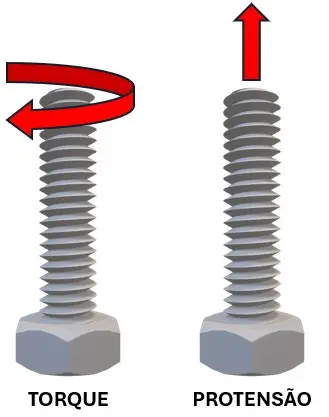
Figure 1: Representation of torque and prestressing.
Types of screw connections and applications
Bolted connections can be specified and installed in different ways, separated by the type of tightening (normal or prestressed) and by the way the shear force is transmitted (by contact or friction). Therefore, understanding the difference between the types of connections and their applications is essential for the safe and economical design of metal structures.
The first differentiation occurs in the type of tightening. According to NBR 8800:2024, normal tightening connections do not require a minimum level of initial prestressing, and it is only necessary to ensure firm contact between the connected parts. Prestressed connections, on the other hand, must be installed in such a way as to ensure that the initial prestressing level specified in the design is achieved when the bolt is installed. Metal structure standards indicate minimum prestressing values equivalent to approximately 70% of the bolt's nominal tensile strength.
Screw connections are also classified according to their behavior under shear stress. Contact connections are connections in which the shear stress is transmitted by contact between the edges of the holes in the plates and the body of the screw. Thus, in this type of connection, all friction between the plates is disregarded in the transmission of stress. Contact connections can be installed with normal tightening or prestressed.
Friction connections are designed to transmit shear forces through friction between the plates. This is ensured by the bonding force generated by the pretension of the bolt, which compresses one plate against the other, and by the coefficient of friction of the plates. Friction connections are more complex and more expensive than other types of connections, as they require the use of prestressed bolts and the preparation of the connected surfaces to ensure a minimum friction coefficient consistent with the value specified in the design. In addition, the resistant force of friction-dimensioned connections is lower than the resistant force of contact connections. For this reason, their use is only recommended in specific cases where slippage of the connection may pose a risk to the integrity and/or proper functioning of the structure.
Figure 2 below shows the types of screw connections, with some examples of their application.
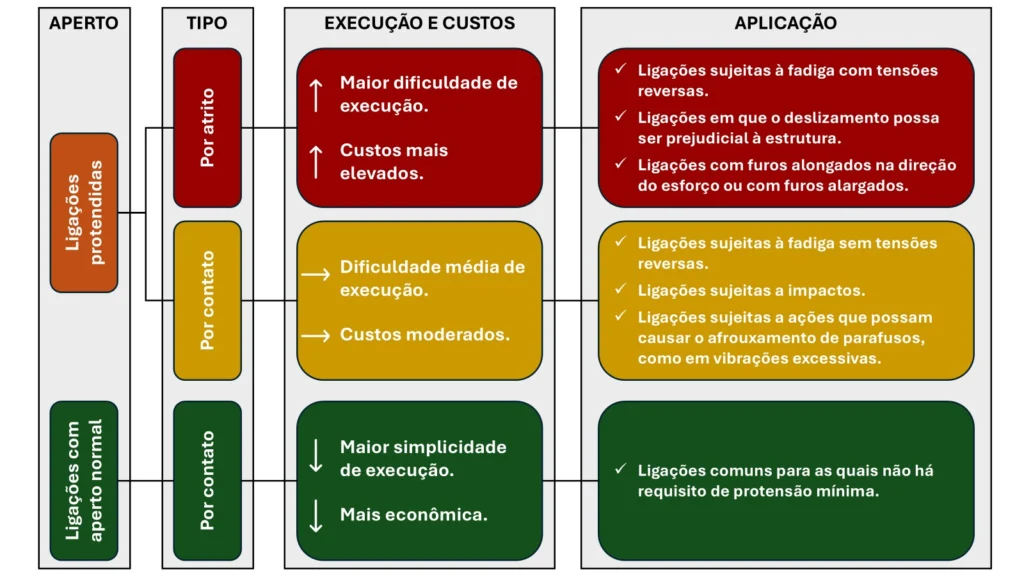
Figure 2: Applications of screw connection types.
Methods for installing bolted connections
NBR 8800:2024 allows the use of different methods for installing bolts with initial prestressing. In this section, the main ones will be briefly discussed.
The first stage of installation in prestressed connections, regardless of the method used, involves applying pre-tension to the connection bolts to ensure that all parts are in full contact. This condition can be achieved with the maximum effort of a worker using a normal wrench or with a few impacts from an impact wrench. The pre-tension condition is sufficient for bolted joints specified with normal tightening, i.e., without a specified minimum initial pre-tension.
Tightening with a calibrated wrench or torque wrench is the most widely known and used installation method for prestressed connections. The method consists of applying a defined torque to the nuts after the joint has been properly compacted in the pre-tensioning stage. To do this, it is necessary to obtain the relationship between the desired prestress and the minimum torque to achieve this bonding force. As mentioned above, torque is an indirect measure of the pretension in the bolt and is influenced, among other factors, by the finish, lubrication, and cleanliness of the parts with relative movement. For this reason, the use of standardized torque tables is not permitted, and the reference value for installation must be defined based on tests defined in the standard.
Another method often used in the installation of prestressed bolted connections is the nut rotation method. In this method, after the bolts have been pre-tensioned, the final tightening is achieved by applying relative rotation between the nut and the bolt. The amount of additional rotation applied is defined in a standard based on the dimensions of the bolt and the configuration of the joint. This method is recognized as more reliable than torque-controlled methods, since the prestressing is obtained by the axial deformation of the bolt (proportional to the thread pitch), bringing the element to an inelastic state, with an initial prestressing greater than the minimum required by the standard. The nut rotation method is illustrated in the following figure.
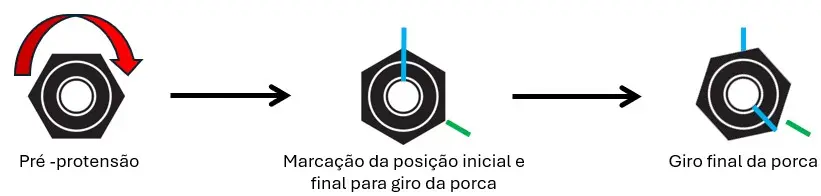
Figure 3: Nut rotation method.
In addition to the methods mentioned above, there are also more sophisticated methods of installing bolts, such as the use of a direct tension indicator or tension-controlled bolts. The first method uses special washers designed to deform under a specified compressive load, indicating that the desired pretension has been achieved in the bolt. Tension-controlled bolts, on the other hand, have a pin at the tip designed to break when the bolt reaches the required pretension. The elements mentioned are illustrated below in Figure 4.
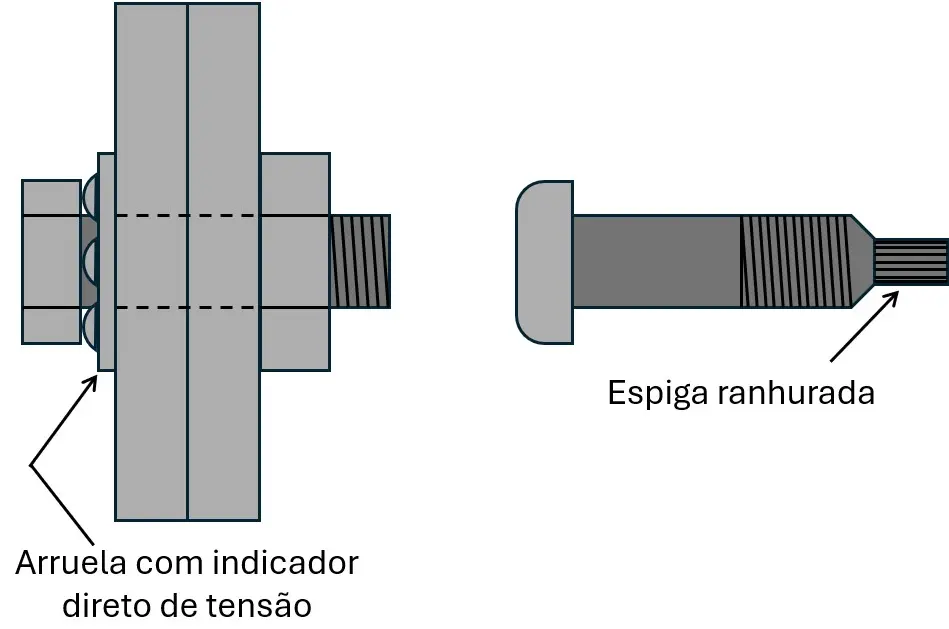
Figure 4: Washer for direct tension indicator and screw with traction control.
Conclusion: Increased safety in the design and installation of bolted connections
Bolted connections are critical points in metal structures whose failure can result in overall collapse. Correct connection sizing and proper specification of the connection type in the design are crucial to ensuring the integrity of the asset. However, to minimize structural risks and ensure that the connection performs as designed, it is necessary that the assembly follow reliable methods that are appropriate for installation under the conditions of the job site.
Independent project monitoring and review, together with manufacturing inspections and assembly monitoring, are essential tools for certifying the quality of the structure.
If you, like our more than 150 clients, are looking for specialized solutions in structural analysis or failure prevention, such as deformation, vibration, and corrosion, consult our team and count on Kot Engenharia.
Our employees are at your disposal to turn your challenges into solutions and boost your results, as we have been doing since 1993. It will be our pleasure to serve you!
Follow our pages on LinkedIn, Facebook and Instagram and continue to follow our content.
FAQ
1. What is the technical difference between prestress and torque in bolted connections?
Although both terms refer to the tightening of a bolt, they have distinct meanings. Initial preload is the actual tensile force that stretches the bolt shank, compressing the joint plates against each other; it is the true measure of the tightening level. Torque, on the other hand, is merely a measure of the force applied to turn the nut. Torque is an indirect measure of preload, and its accuracy is affected by friction between the threads, surfaces, and washers, requiring that lubrication and cleanliness conditions be known.
2. How do normal-tension connections differ from prestressed connections?
According to the criteria of NBR 8800:2024, normal-tightened connections do not require a minimum initial tensile strength; they only require that firm contact between the connected metal parts be ensured. On the other hand, prestressed connections require that the assembly achieve a minimum initial prestressing force pre-established in the design, which is equivalent to approximately 70% of the bolt’s nominal tensile strength.
3. What is the difference between force transmission through contact and through friction?
In contact fasteners, the shear force is transmitted directly by the physical pressure between the bolt shank and the edges of the holes in the plates, disregarding any effect of surface friction. In friction connections, the force is transmitted by the friction generated between the surfaces of the plates, which are tightly squeezed together by the bolt’s pretension force. Friction connections are costly, require special surface preparation, and can withstand lower forces than contact connections; they are recommended only where joint slippage poses a risk to the structural integrity.
4. Why does NBR 8800:2024 prohibit the use of standardized torque tables for prestressed connections?
Since torque is an indirect way of estimating the internal stress of a bolt, the final value is drastically influenced by external variables, such as the material finish, the level of lubrication, and the cleanliness of the parts in relative motion. Due to this high variability in friction, the use of off-the-shelf, generic tables is not permitted; reference torque values for field installation must be strictly defined through standardized practical tests.
5. What are the main advantages of the nut-rotation installation method?
The nut rotation method is recognized as being more reliable than methods controlled exclusively by torque. In this method, following a prestressing step (which ensures full initial contact between the plates), an additional geometric rotation—predefined in the standard based on the bolt’s dimensions—is applied. This generates controlled axial deformation in the bolt along the thread pitch, causing the element to enter the inelastic range and ensuring an initial prestressing force greater than the minimum required.