A Interação Solo-Estrutura (ISE) é a análise de engenharia que considera conjuntamente a deformabilidade e os deslocamentos da infraestrutura, da superestrutura e do maciço de solo (NBR 6122). Ao contrário da abordagem tradicional, que considera o solo como apoio rígido e indeslocável, a consideração da ISE evita diagnósticos equivocados, reduz o risco de recalques diferenciais e garante a estabilidade de obras complexas, como túneis, caminhos de rolamento e bases de equipamentos vibratórios, utilizando modelagens por meio contínuo ou meio discreto (molas de Winkler).
Entenda como a Interação Solo-Estrutura garante a integridade e segurança de obras industriais.
Introduction
It is common practice to design superstructure and substructure elements separately. In this context, the ground is treated as a fixed support, and its influence on the superstructure is disregarded. Similarly, the loads on the fixed supports are used to design the substructure, while the stiffness of the superstructure is disregarded.
In general, the traditional approach can yield satisfactory results, especially in the case of soils with low deformability. There are several situations, however, in which this approach may be incorrect or unfeasible. In such cases, therefore, soil-structure interaction (SSI) should be considered, defined by NBR 6122 [1] as structural analysis processes that jointly consider the deformabilities of the substructure and superstructure.
Furthermore, the advent of numerical methods and their application in the field of structural analysis has led to the adoption of more sophisticated approaches to modeling soil-structure interaction, providing a more realistic and accurate representation of structural behavior. However, modeling this interaction can be a highly complex task.
In other words, soil is a heterogeneous medium resulting from the decomposition of rocks by physical or chemical agents, which may or may not contain decomposed organic matter, with liquid and gas filling the voids between the solid particles. For this reason, its composition—and consequently its physical and mechanical properties—can vary considerably along the soil profile and are difficult to determine.
Finally, Kot has a Civil Engineering team Civil Engineering expertise in structural modeling and analysis, where the consideration of soil-structure interaction is highly recommended—or even essential—enabling the firm to provide reliable engineering solutions to its clients.
Soil-structure interaction and its applications
In general, the soil-structure interaction mechanism can be applied to various types of structures. For example, some of its applications include:
-
- Foundation analysis;
-
- Analysis of containment structures;
-
- Dynamic analysis of structures resting on the ground;
-
- Analysis of underground structures such as tunnels;
-
- Path analysis;
-
- Analysis of structures subjected to significant variable loads, such as silos, bridges, tanks and thickeners;
-
- Analysis of structures sensitive to deformation or supported on highly deformable soils.
Soil-structure interaction and impacts on the behavior of structures
Incorrect consideration or disregard for the mechanism of soil-structure interaction can have negative consequences from the economic, operational and safety points of view.
In this regard, the mismatch between ground and structural movements can lead, in the event of excessive differential settlement (vertical displacement), to a redistribution of stresses in the superstructure elements and in the loads transmitted to the foundation. As a consequence, the presence of undersized components in the structure makes it more susceptible to the occurrence of cracks and unexpected deformations throughout its service life. In extreme cases, the result is the failure of structural elements due to loads not accounted for in the design.
In addition to structural impacts, ground displacement can cause operational issues in structures such as yard machinery. For example, vertical and horizontal misalignments in the running surface (Figure 1) result in increased maintenance requirements and can even lead to a loss of machine stability due to load redistribution.
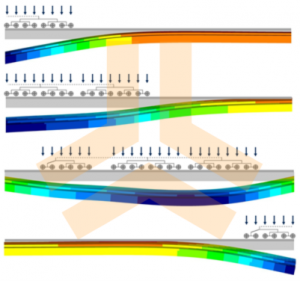
Figure 1: Vertical displacements on a roadway. SOURCE: Kot Collection.
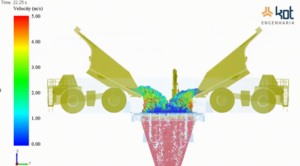
In addition, soil-structure interaction also influences a structure’s dynamic response. Soil stiffness and damping vary depending on its composition. The same structure will exhibit different behaviors depending on the type of soil on which it is founded. In this regard, this aspect is particularly important when dealing with structures subjected to excitation sources such as mills and crusher bases (Figure 2).
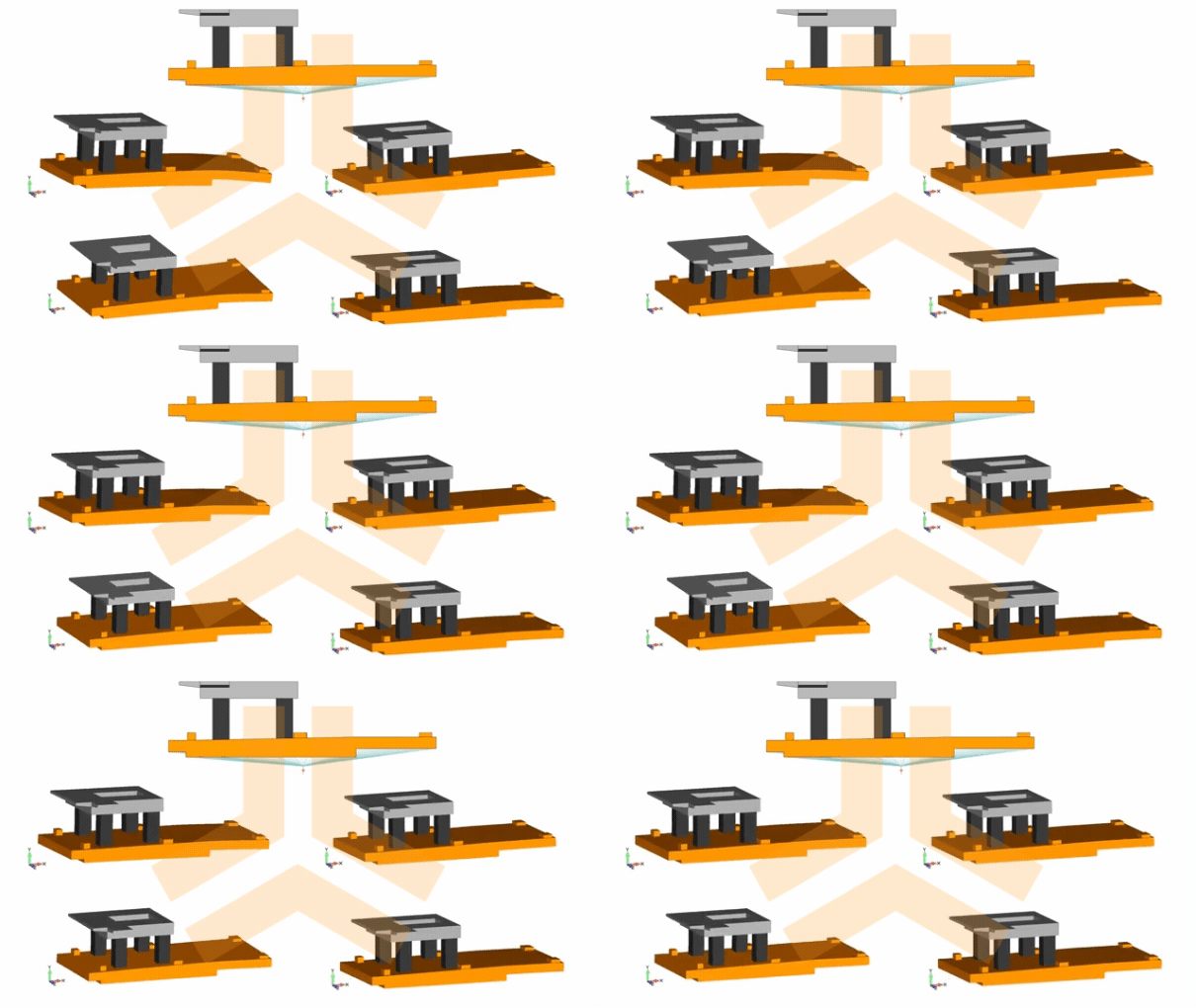
Figure 2: Dynamic analysis of a crusher base supported on soil. SOURCE: Kot Collection.
Soil-structure interaction in design and modeling
In general, the most common approaches to modeling soil-structure interaction (SSI) involve the application of discrete-body and continuous-medium models. Therefore, the approach to be adopted should be determined based on factors related to the behavior of the structure under analysis, material properties, and external loading conditions.
First, in continuous-medium models, the soil mass is treated as a continuous elastic medium and modeled using two-dimensional or three-dimensional elements. This method is a conceptual approximation of the physical representation of infinite soil. Although it provides a more realistic representation of soil behavior, it is a more complex approach. For example, one application is the modeling and analysis of underground structures such as tunnels, as shown in Figure 3.
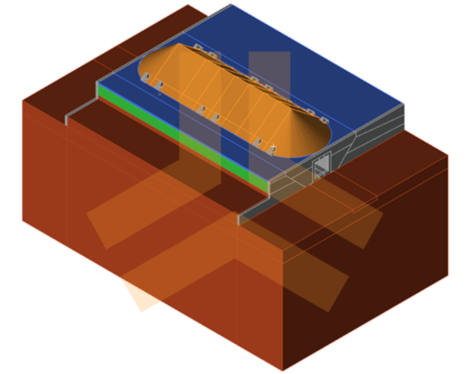
Figure 3: Model of soil as a continuous medium under tunnel. SOURCE: Kot Collection.
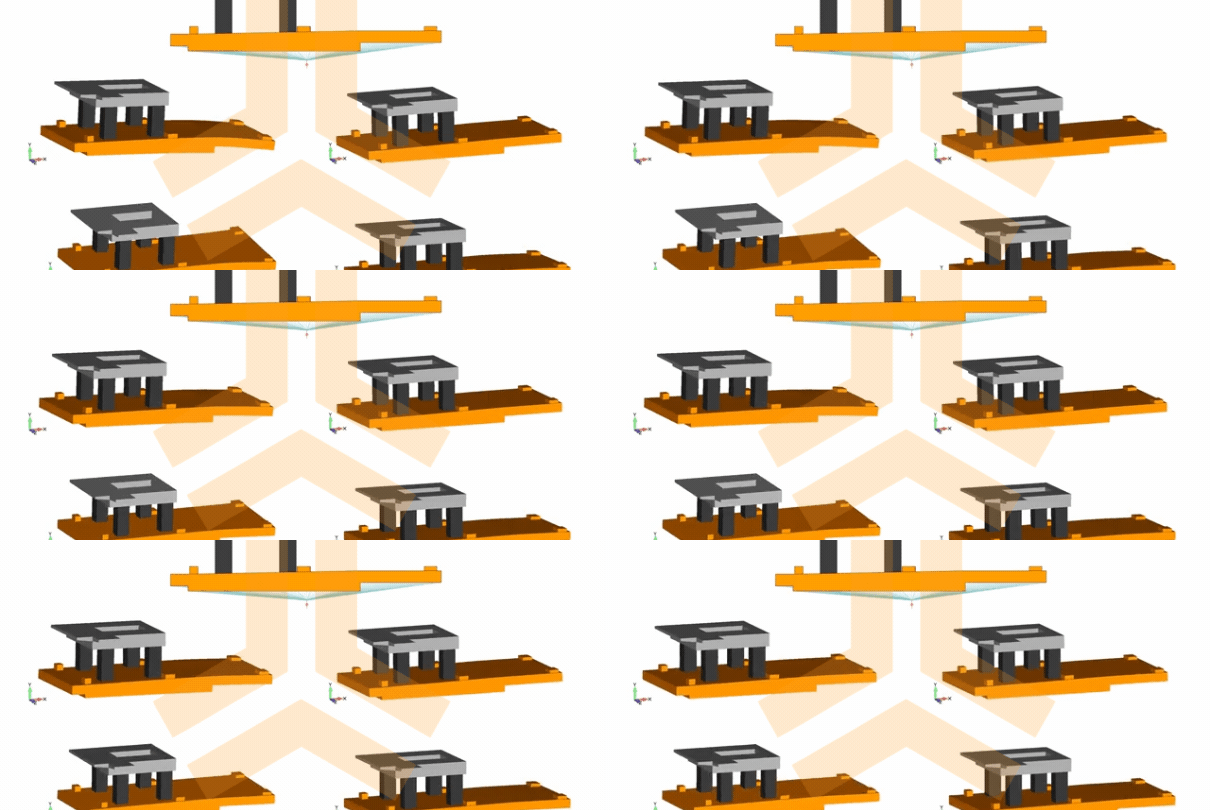
On the other hand, in discrete-element models, soil-structure interaction is represented according to the model proposed by Winkler, using a series of independent springs with linear elastic behavior, in which the stiffness of these springs defines a proportionality constant between the applied pressure and the soil displacement, known as the reaction coefficient [2]. In this sense, this representation is widely used in the modeling of shallow foundations and pile blocks. Figure 4 shows a raft foundation model with soil-structure interaction using springs
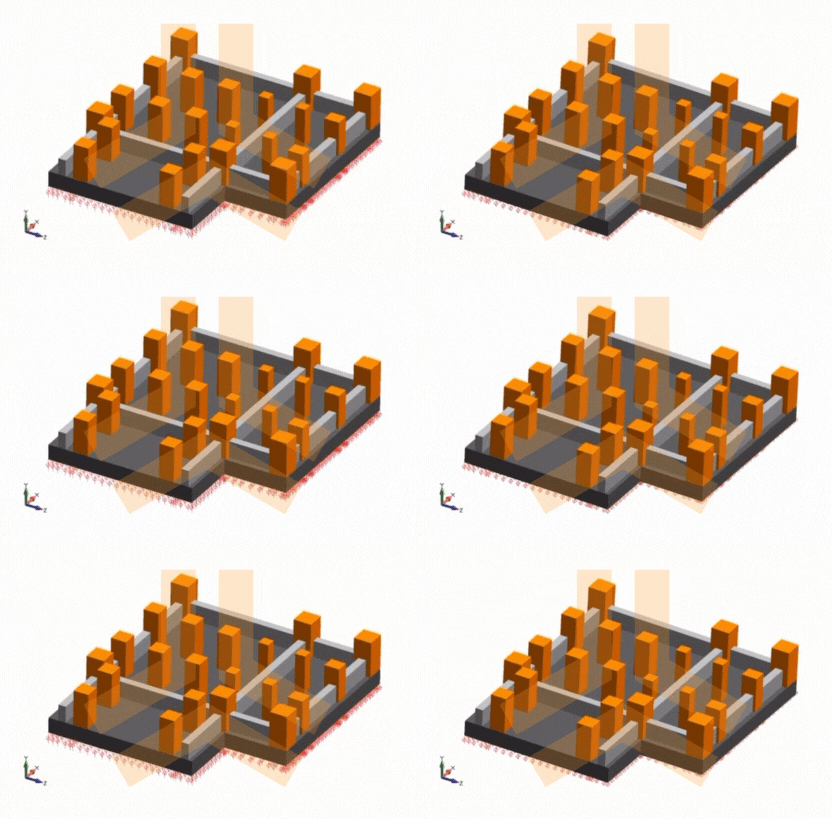
Figure 4: Radier model with soil-structure interaction using springs. SOURCE: Kot Collection.
Modeling soil-structure interaction using springs is the most widely adopted approach, due to its simplicity. However, the main challenge with this model is determining the spring stiffness coefficient, since it is the only parameter used to model soil behavior. The stiffness coefficient depends not only on the nature of the soil but also on the dimensions of the loaded area.
Finally, it should be noted that, regardless of the approach chosen, the analysis of structures that interface with the ground requires a thorough understanding of soil behavior and properties.
Conclusion
In summary, soil-structure interaction (SSI) involves the coordination of displacements between the structure and the soil. In this sense, this mechanism is linked to the behavior and, consequently, the static and dynamic response of a structure under loads. Furthermore, soil-structure interaction is a mechanism of great importance for industrial structures given its unconventional nature.
However, the realistic modeling of soil can be quite complex, mainly due to uncertainties associated with soil behavior and properties. For this reason, an incorrect assessment of soil-structure interaction can compromise the operational performance and safety of a structure.
Kot has a team of qualified professionals in analysis, including ISE (soil-structure interaction), ready to provide reliable and customized engineering solutions. Contact our experts for more information!
Follow our pages on LinkedIn, Facebook e Instagram to keep up with our content.
FAQ
1. O que é a Interação Solo-Estrutura (ISE) e qual a diferença em relação à abordagem tradicional?
-
Abordagem Tradicional: Dimensiona a superestrutura e a infraestrutura de forma isolada. Considera o solo como um apoio rígido e totalmente indeslocável, desprezando a influência da deformabilidade do solo sobre a estrutura e a rigidez da superestrutura sobre as fundações.
-
Interação Solo-Estrutura (ISE): Definida pela norma NBR 6122, é a metodologia que analisa simultaneamente o comportamento e a deformabilidade do solo, das fundações e da superestrutura. A compatibilização dos deslocamentos entre todos esses elementos reflete de forma realista o comportamento real da edificação.
2. Quais são os riscos e prejuízos de ignorar a ISE no projeto de uma estrutura?
A desconsideração do mecanismo de ISE pode causar graves impactos estruturais, operacionais e financeiros:
-
Danos Estruturais: A ocorrência de recalques diferenciais (deslocamentos verticais desiguais) provoca a redistribuição indesejada de esforços. Elementos não dimensionados para essas cargas podem sofrer fissuração excessiva, deformações imprevistas e, em casos extremos, colapso estrutural;
-
Impactos Operacionais: Em equipamentos de pátio e caminhos de rolamento, recalques do solo causam desalinhamentos horizontais e verticais nas trilhas, gerando desgaste severo, paradas não programadas e até perda de estabilidade operacional das máquinas;
-
Alteração da Resposta Dinâmica: O solo altera a rigidez e o amortecimento do sistema. Ignorar a ISE em bases de equipamentos vibratórios (como moinhos e britadores) pode alterar as frequências naturais e gerar vibrações excessivas.
3. Em quais tipos de estruturas a consideração da ISE é mais crítica ou indispensável?
A ISE é especialmente recomendada em obras assentadas sobre solos de alta deformabilidade, bem como em ativos industriais e infraestruturas não convencionais, tais como:
-
Fundações profundas ou superficiais de grande porte (como radiers e blocos sobre estacas);
-
Estruturas de contenção e obras subterrâneas (como túneis e galerias);
-
Caminhos de rolamento para máquinas de pátio (empilhadeiras e retomadoras);
-
Bases de equipamentos com cargas dinâmicas (britadores e moinhos);
-
Estruturas submetidas a grandes variações de carga útil (silos, reservatórios, pontes e espessadores).
4. Como o solo é representado na modelagem computacional de ISE (Meio Contínuo vs. Meio Discreto)?
As duas abordagens mais comuns em modelagem computacional por Elementos Finitos são:
| Método | Como Funciona | Principais Aplicações |
| Meio Contínuo | O solo é modelado como um bloco tridimensional ou bidimensional elástico contínuo, representando o comportamento físico de um meio infinito de forma mais realista e complexa. | Estruturas subterrâneas, túneis e análises geotécnicas profundas. |
| Meio Discreto (Modelo de Winkler) | O solo é simplificado e representado por uma série de molas independentes com comportamento elástico linear. A rigidez é dada pelo coeficiente de reação do solo. | Fundações superficiais, radiers e blocos de estacas. |
References
-
- Brazilian Association of Technical Standards, NBR 6122. Design and execution of foundations, 2022.
-
- CAMPOS. J. C. Elementos de fundação em concreto. Oficina de Textos, São Paulo, 2015.