Engineering technical assistance is essential for the correct clarification of technical issues in legal expert reports, contributing to consistent and well-founded reports. So, keep reading and understand the importance of this specialized support.
Introduction
Firstly, in legal proceedings involving technical engineering issues, the judge does not have the specific technical knowledge to give an opinion or reach a conclusion on the case. In these situations, it may be necessary to conduct a technical engineering assessment. Once the court has determined the need for an assessment, the controversial points that must be resolved by the expert are listed. The judge appoints an expert of his or her choice, who will ultimately be responsible for conducting the necessary procedures to prepare the technical engineering report.
In addition, each party to the proceedings appoints its own technical assistants, who will assist the expert in the work necessary to prepare the technical report. All necessary steps must be accompanied by the parties' technical assistants, in accordance with the civil code.
The parties draw up a series of technical questions, seeking to demonstrate to the expert all the information and technical findings necessary to understand the engineering issues involved in the case. Then, with all the necessary information, the expert draws up the technical report, responding to the court's demands and the answers to the questions drawn up by the parties.
Advanced engineering studies
In this sense, during technical engineering assessments, it is common to prepare high-level technical studies that seek to clarify issues, test hypotheses, or demonstrate technical errors, especially in accidents or situations with significant public repercussions. In this context, the use of advanced engineering tools such as CAE is crucial to demonstrate and prove the technical reality of the facts. Figure 1 shows an example of the use of a computational tool to study reinforced concrete infrastructure.
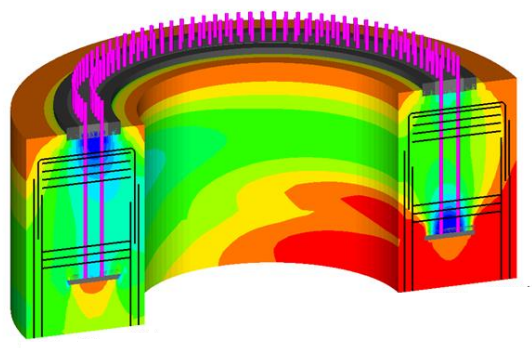
Figure 1 - Stress analysis in a reinforced concrete infrastructure.
Thus, the preparation of these studies gives technical credibility to the technical assistant before the court expert, facilitating decision-making and the formation of a solid technical opinion for the preparation of the expert report.
However, the use of technical standards for conducting these studies is appropriate, provided that care is taken in the use of load increase factors and/or safety factors that are not necessarily present at the time of the study.
Kot is a company recognized in the market for its engineering technical assistance for large companies, with a focus on expertise in large equipment, mining equipment, port equipment, warehouses, cranes, subways, railroads, bridges, infrastructure, stadiums, footbridges, bridges and viaducts.
Laboratory and material analysis
In certain cases, it may be necessary to take samples of materials to check compliance with the design specification.
In the case of machinery and equipment, the main construction material is structural steel, which can present various pathological manifestations, for example: loss of thickness due to corrosion, cracks, dents, instability (buckling), among others. A situation that is not uncommon is the use of steels with mechanical strength or ductility outside the specification. Figure 2 illustrates the evidence from a test carried out in an investigation.
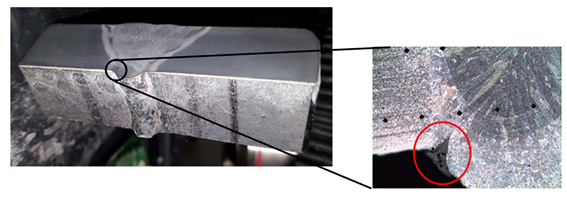
Figure 2 - Metallographic test on a mechanical component weld.
The main structural materials used in infrastructure are steel and concrete. Reinforced concrete, being a composite material, requires special attention. The materials used in the construction of concrete parts play a decisive role in mechanical strength and durability. Specific tests make it possible to identify the current degree of deterioration of a concrete part, and can be decisive in clarifying issues in a technical expert opinion.
The deleterious reactions that occur in concrete (AAR, for example) can significantly reduce the mechanical strength of a piece, so laboratory tests can refute or confirm hypotheses. See an example of the test in Figure 3.
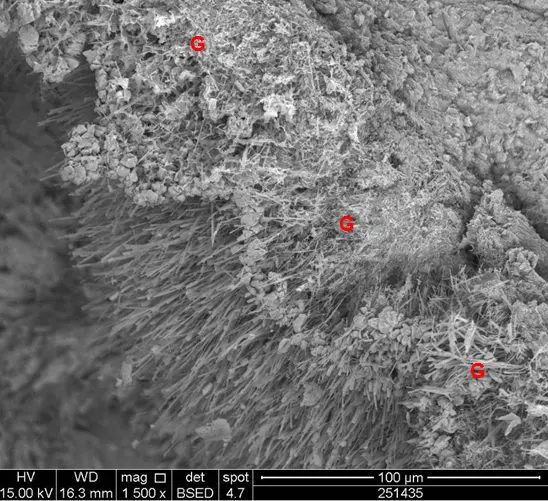
Figure 3 - Scanning electron microscope test on a piece of concrete, showing the presence of gel resulting from alkali-aggregate reaction (AAR).
Important considerations
In summary, technical assistance work in a legal proceeding must be performed by an experienced professional with a high level of technical knowledge in order to provide the court expert with solid and consistent information necessary for a conclusive and technically valid technical report. It is in the interest of both parties in a technical expert examination that the expert report be consistent and technically impartial, avoiding subsequent questions and clarifications, which are always slow and hinder the conclusion of the expert examination.
Kot has a team of qualified professionals for legal technical assistance, advanced engineering analysis, selection, and application of methodologies appropriate for your business and your assets. Consult our team for more information!
Follow our pages on LinkedIn, Facebook e Instagram to keep up with our content.
FAQ
1. Qual é a diferença prática e legal entre o Perito Judicial e o Assistente Técnico de Engenharia?
-
Perito Judicial: É o profissional de confiança nomeado pelo juiz para conduzir as diligências de forma neutra e elaborar o laudo pericial oficial que fundamentará a sentença.
-
Assistente Técnico: É o engenheiro especialista indicado por uma das partes do processo. Ele acompanha 100% das vistorias de campo, formula os quesitos técnicos (perguntas estratégicas), apresenta análises de engenharia para testar hipóteses e elabora o parecer técnico concordando ou divergindo fundamentadamente da conclusão do perito.
2. Como as simulações computacionais (CAE/MEF) ajudam a comprovar hipóteses durante uma perícia judicial?
Em litígios envolvendo acidentes ou colapsos de grande porte (como em pontes, guindastes, metrôs ou equipamentos de mineração), a reconstituição física do evento é impossível ou extremamente onerosa. A utilização de simulações por Elementos Finitos (MEF) permite “recriar” a estrutura no ambiente virtual sob as condições exatas de operação no momento do sinistro. Isso fornece base matemática irrefutável ao assistente técnico para demonstrar visual e numericamente ao perito e ao magistrado a verdadeira causa-raiz da falha.
3. Por que a aplicação rígida de fatores de segurança normativos de projeto pode distorcer a análise de um acidente na perícia?
As normas de projeto utilizam fatores de segurança e majoração de carga conservadores para a construção de novas estruturas, visando absorver incertezas futuras. Contudo, em uma investigação pericial de falha, o objetivo é descobrir o que efetivamente aconteceu na física real daquele instante. Aplicar cegamente fatores de segurança de projeto em um estudo pericial pode simular tensões irreais e mascarar a tensão exata de ruptura do material, levando a conclusões equivocadas sobre as responsabilidades pelo colapso.
4. De que forma os ensaios de microscopia (MEV) e metalografia auxiliam na identificação de falhas ocultas em materiais?
Em disputas judiciais, os danos visíveis na superfície raramente contam a história toda:
-
No Aço: O ensaio metalográfico analisa a microestrutura do metal e das juntas soldadas, comprovando se o componente falhou devido à fadiga mecânica ou porque o fornecedor entregou um aço com dureza, ductilidade ou resistência fora das especificações contratadas.
-
No Concreto: A microscopia eletrônica de varredura (MEV) identifica patologias químicas internas, como a presença do gel cristalino decorrente da Reação Álcali-Agregado (RAA). Esse ensaio prova se a perda de resistência do concreto foi causada por uma reação deletéria intrínseca aos agregados e cimento utilizados na obra.
5. Quais são os riscos de não contar com uma assistência técnica qualificada desde o início da perícia?
Sem um suporte de engenharia qualificado na fase inicial, a parte corre o risco de formulários quesitos genéricos ou ineficazes, perdendo a oportunidade de direcionar a pericia para a realidade dos fatos. Além disso, a falta de dados técnicos robustos impede a contestação fundamentada de um laudo pericial superficial ou equivocado. Isso gera protelações com pedidos de esclarecimentos lentos e pode levar o magistrado a decidir com base em uma premissa técnica errônea, resultando em condenações ou perdas financeiras irreversíveis.